jueves, diciembre 21, 2006


domingo, noviembre 19, 2006
Caos electoral: ¿Golondrinas pirotécnicas?
Estuve siguiendo las elecciones por radio después de las 9.30 de la noche vía rpp, y el panorama reflejado fuera de la ciudad de Lima, al interior del país, era lamentable. (acaba de sonar también en Carmen de la Legua)
Un resultado que de no intervenir la fuerza pública puede tornarse sangriento.
¿Fiesta electoral? ¿Fiesta Brava?
Aquí un extracto remixado de lo emitido por las ondas de rpp.
¿Guerra avisada?
- Electores Golondrinos: La ciudadanía castrada por el Jurado Nacional de Elecciones
Un resultado que de no intervenir la fuerza pública puede tornarse sangriento.
¿Fiesta electoral? ¿Fiesta Brava?
Aquí un extracto remixado de lo emitido por las ondas de rpp.
¿Guerra avisada?
- Electores Golondrinos: La ciudadanía castrada por el Jurado Nacional de Elecciones
domingo, noviembre 05, 2006
¿Dónde han escondido la anchoveta?
Buscar la anchoveta es una tarea difícil. Entre sardinitas, sardinas y sardinillas se esconde uno de nuestros peces más queridos.
sábado, noviembre 04, 2006
Sonidos para no olvidar
He encontrado este sitio para la memoria de nuestros sonidos:
ARCHIVO SONORO
Este sitio:
"... promueve la importancia de adquirir una nueva manera de escuchar el entorno y forma parte de las acciones de personas e instituciones preocupadas en el rescate y conservación del patrimonio intangible de la historia de la humanidad, integrada por encuentros y mezclas entre culturas que han dado como resultado una asombrosa diversidad.
En nuestro país, como en muchos otros, convive una prodigiosa pluralidad de culturas e identidades, cada lugar se significa de diversas maneras. Los diferentes hombres y mujeres han creado sus manifestaciones culturales a partir de sus relaciones con los elementos de la naturaleza, creando una cultura propia con influencia de culturas vecinas, tejiendo así una singular gama de costumbres y tradiciones.
¿Qué pasa con esos sonidos que nunca más se van a escuchar? Voces y sonidos en los cafetales, ingenios azucareros, platanares, milpas, bosques, selvas, cerros, mares, ríos caudalosos, lagunas, presas, templos, cuevas, parques, panteones, edificios arqueológicos y en las urbes, que son elementos culturales que integran una diversidad vigorosa y actual.
Este archivo sonoro será un punto de referencia, comunicación e intercambio entre habitantes de Chiapas, con otros del país y del mundo, interesados en conocer la distinción que existe en los lugares en que habitan, debido a sus diferencias; de esta manera se brinda la oportunidad de que generaciones siguientes conozcan parte de su historia.
Si bien es cierto no somos expertos en la realización de archivos sonoros y no contamos con equipos sofisticados, pero eso no resta el interés y la disposición que tenemos para no sólo aprender a escuchar nuestro entorno y a disfrutar de él, sino para seleccionar y archivar; esperamos que con el intercambio de sonidos a través de donaciones conocer el paisaje sonoro de otros lugares y este sitio se convierta en un espacio de aprendizaje, gozo e intercambio. "
ARCHIVO SONORO
Este sitio:
"... promueve la importancia de adquirir una nueva manera de escuchar el entorno y forma parte de las acciones de personas e instituciones preocupadas en el rescate y conservación del patrimonio intangible de la historia de la humanidad, integrada por encuentros y mezclas entre culturas que han dado como resultado una asombrosa diversidad.
En nuestro país, como en muchos otros, convive una prodigiosa pluralidad de culturas e identidades, cada lugar se significa de diversas maneras. Los diferentes hombres y mujeres han creado sus manifestaciones culturales a partir de sus relaciones con los elementos de la naturaleza, creando una cultura propia con influencia de culturas vecinas, tejiendo así una singular gama de costumbres y tradiciones.
¿Qué pasa con esos sonidos que nunca más se van a escuchar? Voces y sonidos en los cafetales, ingenios azucareros, platanares, milpas, bosques, selvas, cerros, mares, ríos caudalosos, lagunas, presas, templos, cuevas, parques, panteones, edificios arqueológicos y en las urbes, que son elementos culturales que integran una diversidad vigorosa y actual.
Este archivo sonoro será un punto de referencia, comunicación e intercambio entre habitantes de Chiapas, con otros del país y del mundo, interesados en conocer la distinción que existe en los lugares en que habitan, debido a sus diferencias; de esta manera se brinda la oportunidad de que generaciones siguientes conozcan parte de su historia.
Si bien es cierto no somos expertos en la realización de archivos sonoros y no contamos con equipos sofisticados, pero eso no resta el interés y la disposición que tenemos para no sólo aprender a escuchar nuestro entorno y a disfrutar de él, sino para seleccionar y archivar; esperamos que con el intercambio de sonidos a través de donaciones conocer el paisaje sonoro de otros lugares y este sitio se convierta en un espacio de aprendizaje, gozo e intercambio. "
No olvidar: etiquetas para Perublogs y Technorati
habrá alguna herramienta similar para Blogsperú?
Aquí el enlace:
Mi wp-plugin, etiquetas para Perublogs
(no lohe probado en blogger solo en wordpress)
Además la funcionalidad de los "playlists" en Youtube, descrita por Juan Carlos Luján.
Acabo de implementar este avance a los videos que cuelgo en una página simpática.
Aquí el enlace:
Mi wp-plugin, etiquetas para Perublogs
(no lohe probado en blogger solo en wordpress)
Además la funcionalidad de los "playlists" en Youtube, descrita por Juan Carlos Luján.
Acabo de implementar este avance a los videos que cuelgo en una página simpática.
martes, octubre 31, 2006
Fui a más lugares...
¿OPinar o no opinar en los blogs?
Hoy me di una vuelta por los siguientes blogs...
http://lasburbujasinvisibles.wordpress.com
"Volviendo al anonimato. Yo tengo una familia que cuidar, y no tengo a ninguna gran organización detrás mío para invocar su protección en caso de que a alguien piense que yo debería dejar de opinar en la blogósfera. Ojo, amigos blogueros. En eso, todos ustedes están igual que yo. Es verdad que no tenemos “filtros” como dijo Rosa María Palacios: pero tampoco tenemos protección, en caso de que alguien piense que nuestra opinión debe ser censurada. Las campañas de Amnesty son muy bien intencionadas, pero en la práctica no son más que gestos líricos para el público. Muchos aplausos y nada de función."
Sobre la red EMAX, Genaro y competir con telefónica..
http://e-nredados.blogspot.com/
"Creo que el asociar la marca EMax con "papa upa" no fue lo mejor que les pudo pasar, muchos van a pensárselo dos veces antes de comprarle a él. Una pena, pero si no fuera por eso, ¿por qué no despega EMax? Ni sombra le ha hecho a Speedy. Por lo menos hasta ahora. Algún amigo de e-nredados se conecta vía EMax? por favor avisarme para poder contactarlo y preguntarle qué tal, hasta ahora no conocí a nadie que lo hiciera."
¡¡¡Un aparato mp3 con forma de cruz!!
http://michperu.blogspot.com/
"Muchas personas se preguntan ¿quién podría adquirir una de estas excentricidades religiosas? …IDK, pero si existen aretes, anillos, brazaletes, polos, etc. con el símbolo cristiano por que no un reproductor MP3. "
Federico Danton de óvulos congelados en un blog..
http://brujo-politico.blogspot.com/
"nos atrevemos a lanzar una temeraria pero probable hipótesis: Alan García inicia su relación amorosa durante los años de su primer gobierno. Elizabeth Roxanne Cheesman se enamora y acepta una relación paralela en las sombras durante años, continuándola aun en el exilio del mandatario en Colombia y Francia.
Elizabeth Roxanne congela sus óvulos antes de terminar su edad reproductiva normal y espera convencer a Alan García, para encargar retoño. Pasan los años y la devota Elizabeth logra que el maduro Alan, separado de Pilar se sienta mas unido a ella y deciden encargar para satisfacer la ansiada maternidad de Elizabeth Roxanne, para lo cual previsoramente había tomado las previsiones que la ciencia ahora permiten."
Un submarino venezolano para detectar fugas ...
http://bajaenergys.blogspot.com/
PDVSA desarrolla submarino autónomo para detección de fugas en tuberías sumergidas...
Fui a más lugares, pero toma demasiado tiempo indexarlas, así que abandono mi hoja de ruta. Para otra vez será...
Hoy me di una vuelta por los siguientes blogs...
http://lasburbujasinvisibles.wordpress.com
"Volviendo al anonimato. Yo tengo una familia que cuidar, y no tengo a ninguna gran organización detrás mío para invocar su protección en caso de que a alguien piense que yo debería dejar de opinar en la blogósfera. Ojo, amigos blogueros. En eso, todos ustedes están igual que yo. Es verdad que no tenemos “filtros” como dijo Rosa María Palacios: pero tampoco tenemos protección, en caso de que alguien piense que nuestra opinión debe ser censurada. Las campañas de Amnesty son muy bien intencionadas, pero en la práctica no son más que gestos líricos para el público. Muchos aplausos y nada de función."
Sobre la red EMAX, Genaro y competir con telefónica..
http://e-nredados.blogspot.com/
"Creo que el asociar la marca EMax con "papa upa" no fue lo mejor que les pudo pasar, muchos van a pensárselo dos veces antes de comprarle a él. Una pena, pero si no fuera por eso, ¿por qué no despega EMax? Ni sombra le ha hecho a Speedy. Por lo menos hasta ahora. Algún amigo de e-nredados se conecta vía EMax? por favor avisarme para poder contactarlo y preguntarle qué tal, hasta ahora no conocí a nadie que lo hiciera."
¡¡¡Un aparato mp3 con forma de cruz!!
http://michperu.blogspot.com/
"Muchas personas se preguntan ¿quién podría adquirir una de estas excentricidades religiosas? …IDK, pero si existen aretes, anillos, brazaletes, polos, etc. con el símbolo cristiano por que no un reproductor MP3. "
Federico Danton de óvulos congelados en un blog..
http://brujo-politico.blogspot.com/
"nos atrevemos a lanzar una temeraria pero probable hipótesis: Alan García inicia su relación amorosa durante los años de su primer gobierno. Elizabeth Roxanne Cheesman se enamora y acepta una relación paralela en las sombras durante años, continuándola aun en el exilio del mandatario en Colombia y Francia.
Elizabeth Roxanne congela sus óvulos antes de terminar su edad reproductiva normal y espera convencer a Alan García, para encargar retoño. Pasan los años y la devota Elizabeth logra que el maduro Alan, separado de Pilar se sienta mas unido a ella y deciden encargar para satisfacer la ansiada maternidad de Elizabeth Roxanne, para lo cual previsoramente había tomado las previsiones que la ciencia ahora permiten."
Un submarino venezolano para detectar fugas ...
http://bajaenergys.blogspot.com/
PDVSA desarrolla submarino autónomo para detección de fugas en tuberías sumergidas...
Fui a más lugares, pero toma demasiado tiempo indexarlas, así que abandono mi hoja de ruta. Para otra vez será...
domingo, octubre 29, 2006
martes, octubre 10, 2006
domingo, octubre 08, 2006
Arte culto y arte popular
Entrevista completa a John Carey de Juana Libedinsky en el diario LA NACION sobre la superioridad del arte culto y el arte popular.
Por si se pierde...
----
CULTURA
"EL ARTE CULTO NO ES SUPERIOR AL POPULAR"
11/09/2006 | Lo afirma el profesor inglés John Carey, cuyo último libro causó gran polémica.
--------------------------------------------------------------------------------
Lo afirma el profesor inglés John Carey, cuyo último libro causó gran polémica
La “Mona Lisa” no es, intrínsecamente, mejor que un paisaje de Calamuchita hecho por el pintor del pueblo. El Estado no debería financiar las salas de ópera lujosas. La televisión –telenovelas y reality shows, incluidos– es el gran invento cultural del último medio siglo. No hay obras de arte más importantes que otras.
Curiosamente, quien dice esto no viene exactamente de las antípodas de la alta cultura. John Carey es profesor emérito de la Universidad de Oxford, decano de los críticos literarios de The Sunday Times, presidente del jurado que elige al premio Booker (el más importante de la literatura anglosajona), biógrafo de Thackeray y de John Donne, miembro de la Academia Británica y amante de los placeres más refinados de la vida civilizada.
Pero en su último libro, “¿Para qué sirven las artes?”, que publicará en castellano Siglo XXI, no duda en salir con los tapones de punta ante cualquier afirmación de que el arte que les gusta a sus elegantes pares de toga sea mejor que el que disfruta la vecina del barrio en chancletas y con los ruleros puestos.
En el polémico best-seller que tiene divididos a los intelectuales británicos ("Incisivo y brillante", según The Guardian; libro favorito del año para The Independent; idiota para The Times), Carey, nacido en 1934, argumenta que el arte es todo aquello que alguien alguna vez haya pensado que es arte.
"No existen estándares objetivos para juzgar qué obras son superiores", dice, en diálogo con LA NACION, tomando una taza de té en los idílicos jardines de Merton College.
El celebrado autor de "Los intelectuales y las masas. Orgullo y prejuicio en la i ntelligentsia literaria, 1800-1939" se declara espantado por el apoyo financiero que dan los Estados a lo que denomina "la cultura culta".
"Es ridículo usar el argumento de que hay que destinar fondos públicos a la alta cultura porque es la manera de permitir el acceso de las masas a lo que es considerado el buen arte, para que aprendan a valorarlo -dice-. Hasta ahora eso nunca se ha dado. Se ha estudiado la composición de los visitantes a museos en distintas partes del mundo, por ejemplo, y el resultado es que cuando la entrada es gratuita no cambia sustancialmente la composición demográfica. Lo mismo ocure con los teatros nacionales. Entonces, no creo que aquellos a quienes no les gusta la ópera o no quieren ir a la ópera deban financiar con sus impuestos a los que sí quieren. En particular, yo odio la ópera del Covent Garden, un edificio tan lujoso que mucha gente se sentiría socialmente fuera de lugar allí, y que da el mensaje de que la ópera, la clase alta y el lujo son cosas que, naturalmente, van juntas. No es un mensaje que deba darse con los fondos públicos."
-Pero, por ejemplo, en el caso del Teatro Colón, en la Argentina, un argumento que se esgrime es que el Estado debe mantenerlo porque es parte de nuestro orgullo nacional. ¿No es una idea válida?
-Es interesante, porque con el argumento del orgullo nacional es como nacieron las grandes colecciones nacionales. El Louvre, por ejemplo, se armó con las obras que Napoleón iba robando de otros países. Hitler también robó vilmente escudándose en el argumento del orgullo nacional. El arte es lo mismo que el equipo de fútbol: usarlo para el orgullo nacional es un error. Es cierto, Blair va a llevar a algún otro jefe de Estado a nuestro museo, pero el arte no tiene nada que ver con permitirle al señor Blair que se luzca. Es la gente común la que tiene que comprometerse con el arte, participando, y no sólo mirando de lejos con admiración. Por ejemplo, para lo único que está probado en parte que sirve el arte es para proyectos como la reinserción de los presos en la comunidad, de gente con comportamientos antisociales. Pero las grandes sumas estatales van a las instituciones de prestigio que las masas, se supone, deben visitar para elevarse y cosas así.
-¿Cómo surgió la idea de alzarse contra la superioridad del arte culto?
-Mi libro anterior fue sobre los intelectuales modernistas británicos, como Virginia Woolf, D.H. Lawrence, T.S. Eliot, y su relación con las masas, sobre la forma en que reaccionaron a la cultura popular. Lo resumo en dos palabras: la odiaban. Odiaban a las masas y querían eliminarlas, eran intelectuales que dijeron cosas extremadamente violentas contra quienes no tenían su mismo gusto. Así surgió mi interés en ver por qué hay tanta gente que venera el arte culto y lo siente superior al popular. Quise ver si podía encontrar razones que lo justificaran. Por supuesto, tuve que arrancar con la pregunta de qué constituye una obra de arte. Y cuanto más investigué, más fascinante me resultó el tema, porque, sobre todo después de Duchamp y de Warhol, no pude encontrar explicaciones que sigan sirviendo. ¿Qué psicólogo va a aceptar que una obra de arte sea algo que nos hace mejores personas, como creen quienes dicen que te eleva o que da mayor sensibilidad? Otros siguen creyendo que una obra de arte es aquella elegida por Dios, pero me cuesta creer que podamos saber qué elige Dios. Finalmente, lo que ocurre es que si decimos que una obra de arte es superior a otra -y la gente lo dice-, lo que estamos diciendo es que el sentimiento que nos provoca es superior al sentimiento que otro tipo de arte provoca en otra gente. Eso es absurdo, porque nunca vamos a poder saber qué pasa por la cabeza de los demás. Jamás podremos sentir lo que otros sienten. Al final, todo es opinión y subjetividad, cosa que vuelve locos a los expertos.
-¿La Mona Lisa no es intrínsecamente mejor que un paisaje de Calamuchita pintado por el artista del pueblo?
-No creo que sea intrínsecamente mejor. El experimento mental para darse cuenta es suponer que los seres humanos ya no existen y que Dios tampoco existe. ¿Tendría la Mona Lisa valor en ese caso? No; las obras de arte tienen valor porque alguien les da valor. Que mucha gente piense que la Mona Lisa es valiosa y que signifique algo para ellos obviamente es importante, pero eso no quiere decir que aquel que prefiera la pintura de su barrio esté errado de la misma manera que estaría errado si hubiera hecho una suma mal o deletreado mal una palabra. No existe un examen objetivo para certificar que la Mona Lisa es mejor. Su superioridad no puede medirse. Y no hay por qué hacer sentir avergonzada a la gente que no le gusta algo que es considerado una obra de arte. Además, aunque hubiera leyes objetivas en la estética, sería muy difícil encontrar aquellas que atravesaran todas las culturas. En el arte occidental, por ejemplo, la destreza del artista y su originalidad son muy importantes. En cambio, para la cultura oriental lo que tiene valor es mantenerse dentro de la tradición. La calidad de un dibujo de Miguel Angel comparado con el de un niño es sólo evidente dentro de una cultura familiarizada con ese tipo de arte. Frente a obras de tradiciones radicalmente distintas, la mayor parte de nosotros estaría perdido. Por eso, decir que un tipo de arte es superior al otro es ridículo y ofensivo, aunque muchos lo hagan.
-¿Cree que la literatura es superior a todo tipo de arte visual?
-La literatura es el único arte que estimula la energía imaginativa. Al leer, hay que ir imaginando la acción. Nada está ya dado por una imagen. Una imagen puede dar placer de muchas maneras, pero al final siempre volvemos a sus trazos y colores, mientras que la literatura va cambiando con cada lectura. Es un medio mucho más fluido. Por otra parte, la literatura es el único medio que puede criticar argumentativamente, dado que su medio es el lenguaje, el vehículo por excelencia del pensamiento racional, que a la vez puede moralizar. Hay conceptos como la libertad que sólo pueden expresarse con palabras, a pesar de lo que diga el arte conceptual. Para mí, sin duda la literatura es el arte superior, pero para ser coherente insisto en que esto es una cuestión de gusto, subjetiva. A mi hijo, que es músico, le gusta más la música justamente porque no puede argumentar, pero en cambio puede dar los sentimientos puros que uno tiene al argumentar.
-¿Le gusta el arte conceptual?
-No obtengo ningún placer de él, pero reconozco que sirvió para ampliar lo que la gente piensa que es una obra de arte y para mostrar cuán subjetivo es todo. Lo que sí me molesta es cómo los críticos de arte intentan explicar los "conceptos" detrás de estas obras de manera pomposa e inentendible, y cómo muchas veces, financiado con fondos públicos, el arte conceptual se usa meramente para escandalizar al ciudadano medio.
-En Buenos Aires, Spencer Tunick armó fotos de desnudos masivos en la vía pública y mucha gente se ofendió. ¿Qué opina?
-Creo que estaría de acuerdo con la gente que se ofendió. El arte a veces está destinado a ofender, y está bien que así sea. Estoy pensando en las caricaturas políticas que ofenden a un dictador, por ejemplo. Pero me preocupa la superioridad de quienes dicen que el arte que ofende a la gente menos sofisticada es algo bueno, que hay que ampliarle la mente a esta gente estrecha para que se vuelva más como uno, porque somos mejores. Es un argumento sospechoso. El valor de escandalizar, por sí mismo, es escaso, puesto que con abrir un diario o con encender la televisión las noticias, solitas, lo hacen todo el tiempo. Si el arte se suma a lo mismo, puede alejar, más que acercar a la gente. Si el arte da el mensaje de que es algo elitista y de que quienes lo aprecian se sienten superiores y quieren convertir a los demás a su manera de pensar, eso no va a acercar a nadie. Por el contrario: los artistas tienen que mostrar buenas maneras, transmitir su mensaje de manera inteligente, y no ofensiva. Creo que en el caso de Tunick en Buenos Aires, yo hubiera estado con los puritanos
-¿Y qué hay de la televisión, tan vilipendiada? A usted le gusta
-La televisión es el gran invento de mediados del siglo XX que cambió la vida cultural para mejor. Mucha gente jamás hubiera visto una obra de teatro o una ópera de otra manera. Mi propia madre vio una obra de teatro de Shakespeare por primera vez en la TV. La obra no le gustó nada, pero al menos así la vio. La televisión es este objeto maravilloso que enriqueció la vida de millones de personas. Cuando el cable está tan popularizado y hay tantas opciones, criticar a la televisión es algo que no debería hacerse más. Los mismos argumentos se usaban respecto de la radio. Las cosas que George Orwell decía, incluso respecto de escuchar una sinfonía en la radio como una basura para las clases bajas, hoy resultan increíbles. La televisión es muy buena para adaptar clásicos e introducir a mucha gente en libros que de otro modo nunca leería. Es cierto: con las dramatizaciones se pierde el ejercicio de imaginación que implica la lectura. Pero es una buena introducción a los clásicos para millones. La TV es de un alto valor cultural.
-Pero la mayor parte de los televidentes, supongo, no ven debates ni obras de Shakespeare, sino reality shows y telenovelas
-Las telenovelas hoy están escritas de manera muy cuidadosa por gente que sabe. No pueden descartarse como basura. Reality shows en realidad yo no veo tantos, pero es imposible suponer que algo así no tenga valor, porque no tendría la audiencia que tiene. Creo que, a diferencia de las telenovelas, los reality shows desaparecerán, porque es muy difícil mantener interesada a la audiencia por mucho tiempo y al final todo es sexo y ver comer a los participantes, lo que resulta tedioso. La escritora Germaine Greer fue a "Gran Hermano" y dijo que se había arrepentido de haberlo hecho. Pero que hasta una intelectual haya elegido participar en un reality show ya dice algo importante, ¿no le parece?
Juana Libedinsky
LA NACION
Por si se pierde...
----
CULTURA
"EL ARTE CULTO NO ES SUPERIOR AL POPULAR"
11/09/2006 | Lo afirma el profesor inglés John Carey, cuyo último libro causó gran polémica.
--------------------------------------------------------------------------------
Lo afirma el profesor inglés John Carey, cuyo último libro causó gran polémica
La “Mona Lisa” no es, intrínsecamente, mejor que un paisaje de Calamuchita hecho por el pintor del pueblo. El Estado no debería financiar las salas de ópera lujosas. La televisión –telenovelas y reality shows, incluidos– es el gran invento cultural del último medio siglo. No hay obras de arte más importantes que otras.
Curiosamente, quien dice esto no viene exactamente de las antípodas de la alta cultura. John Carey es profesor emérito de la Universidad de Oxford, decano de los críticos literarios de The Sunday Times, presidente del jurado que elige al premio Booker (el más importante de la literatura anglosajona), biógrafo de Thackeray y de John Donne, miembro de la Academia Británica y amante de los placeres más refinados de la vida civilizada.
Pero en su último libro, “¿Para qué sirven las artes?”, que publicará en castellano Siglo XXI, no duda en salir con los tapones de punta ante cualquier afirmación de que el arte que les gusta a sus elegantes pares de toga sea mejor que el que disfruta la vecina del barrio en chancletas y con los ruleros puestos.
En el polémico best-seller que tiene divididos a los intelectuales británicos ("Incisivo y brillante", según The Guardian; libro favorito del año para The Independent; idiota para The Times), Carey, nacido en 1934, argumenta que el arte es todo aquello que alguien alguna vez haya pensado que es arte.
"No existen estándares objetivos para juzgar qué obras son superiores", dice, en diálogo con LA NACION, tomando una taza de té en los idílicos jardines de Merton College.
El celebrado autor de "Los intelectuales y las masas. Orgullo y prejuicio en la i ntelligentsia literaria, 1800-1939" se declara espantado por el apoyo financiero que dan los Estados a lo que denomina "la cultura culta".
"Es ridículo usar el argumento de que hay que destinar fondos públicos a la alta cultura porque es la manera de permitir el acceso de las masas a lo que es considerado el buen arte, para que aprendan a valorarlo -dice-. Hasta ahora eso nunca se ha dado. Se ha estudiado la composición de los visitantes a museos en distintas partes del mundo, por ejemplo, y el resultado es que cuando la entrada es gratuita no cambia sustancialmente la composición demográfica. Lo mismo ocure con los teatros nacionales. Entonces, no creo que aquellos a quienes no les gusta la ópera o no quieren ir a la ópera deban financiar con sus impuestos a los que sí quieren. En particular, yo odio la ópera del Covent Garden, un edificio tan lujoso que mucha gente se sentiría socialmente fuera de lugar allí, y que da el mensaje de que la ópera, la clase alta y el lujo son cosas que, naturalmente, van juntas. No es un mensaje que deba darse con los fondos públicos."
-Pero, por ejemplo, en el caso del Teatro Colón, en la Argentina, un argumento que se esgrime es que el Estado debe mantenerlo porque es parte de nuestro orgullo nacional. ¿No es una idea válida?
-Es interesante, porque con el argumento del orgullo nacional es como nacieron las grandes colecciones nacionales. El Louvre, por ejemplo, se armó con las obras que Napoleón iba robando de otros países. Hitler también robó vilmente escudándose en el argumento del orgullo nacional. El arte es lo mismo que el equipo de fútbol: usarlo para el orgullo nacional es un error. Es cierto, Blair va a llevar a algún otro jefe de Estado a nuestro museo, pero el arte no tiene nada que ver con permitirle al señor Blair que se luzca. Es la gente común la que tiene que comprometerse con el arte, participando, y no sólo mirando de lejos con admiración. Por ejemplo, para lo único que está probado en parte que sirve el arte es para proyectos como la reinserción de los presos en la comunidad, de gente con comportamientos antisociales. Pero las grandes sumas estatales van a las instituciones de prestigio que las masas, se supone, deben visitar para elevarse y cosas así.
-¿Cómo surgió la idea de alzarse contra la superioridad del arte culto?
-Mi libro anterior fue sobre los intelectuales modernistas británicos, como Virginia Woolf, D.H. Lawrence, T.S. Eliot, y su relación con las masas, sobre la forma en que reaccionaron a la cultura popular. Lo resumo en dos palabras: la odiaban. Odiaban a las masas y querían eliminarlas, eran intelectuales que dijeron cosas extremadamente violentas contra quienes no tenían su mismo gusto. Así surgió mi interés en ver por qué hay tanta gente que venera el arte culto y lo siente superior al popular. Quise ver si podía encontrar razones que lo justificaran. Por supuesto, tuve que arrancar con la pregunta de qué constituye una obra de arte. Y cuanto más investigué, más fascinante me resultó el tema, porque, sobre todo después de Duchamp y de Warhol, no pude encontrar explicaciones que sigan sirviendo. ¿Qué psicólogo va a aceptar que una obra de arte sea algo que nos hace mejores personas, como creen quienes dicen que te eleva o que da mayor sensibilidad? Otros siguen creyendo que una obra de arte es aquella elegida por Dios, pero me cuesta creer que podamos saber qué elige Dios. Finalmente, lo que ocurre es que si decimos que una obra de arte es superior a otra -y la gente lo dice-, lo que estamos diciendo es que el sentimiento que nos provoca es superior al sentimiento que otro tipo de arte provoca en otra gente. Eso es absurdo, porque nunca vamos a poder saber qué pasa por la cabeza de los demás. Jamás podremos sentir lo que otros sienten. Al final, todo es opinión y subjetividad, cosa que vuelve locos a los expertos.
-¿La Mona Lisa no es intrínsecamente mejor que un paisaje de Calamuchita pintado por el artista del pueblo?
-No creo que sea intrínsecamente mejor. El experimento mental para darse cuenta es suponer que los seres humanos ya no existen y que Dios tampoco existe. ¿Tendría la Mona Lisa valor en ese caso? No; las obras de arte tienen valor porque alguien les da valor. Que mucha gente piense que la Mona Lisa es valiosa y que signifique algo para ellos obviamente es importante, pero eso no quiere decir que aquel que prefiera la pintura de su barrio esté errado de la misma manera que estaría errado si hubiera hecho una suma mal o deletreado mal una palabra. No existe un examen objetivo para certificar que la Mona Lisa es mejor. Su superioridad no puede medirse. Y no hay por qué hacer sentir avergonzada a la gente que no le gusta algo que es considerado una obra de arte. Además, aunque hubiera leyes objetivas en la estética, sería muy difícil encontrar aquellas que atravesaran todas las culturas. En el arte occidental, por ejemplo, la destreza del artista y su originalidad son muy importantes. En cambio, para la cultura oriental lo que tiene valor es mantenerse dentro de la tradición. La calidad de un dibujo de Miguel Angel comparado con el de un niño es sólo evidente dentro de una cultura familiarizada con ese tipo de arte. Frente a obras de tradiciones radicalmente distintas, la mayor parte de nosotros estaría perdido. Por eso, decir que un tipo de arte es superior al otro es ridículo y ofensivo, aunque muchos lo hagan.
-¿Cree que la literatura es superior a todo tipo de arte visual?
-La literatura es el único arte que estimula la energía imaginativa. Al leer, hay que ir imaginando la acción. Nada está ya dado por una imagen. Una imagen puede dar placer de muchas maneras, pero al final siempre volvemos a sus trazos y colores, mientras que la literatura va cambiando con cada lectura. Es un medio mucho más fluido. Por otra parte, la literatura es el único medio que puede criticar argumentativamente, dado que su medio es el lenguaje, el vehículo por excelencia del pensamiento racional, que a la vez puede moralizar. Hay conceptos como la libertad que sólo pueden expresarse con palabras, a pesar de lo que diga el arte conceptual. Para mí, sin duda la literatura es el arte superior, pero para ser coherente insisto en que esto es una cuestión de gusto, subjetiva. A mi hijo, que es músico, le gusta más la música justamente porque no puede argumentar, pero en cambio puede dar los sentimientos puros que uno tiene al argumentar.
-¿Le gusta el arte conceptual?
-No obtengo ningún placer de él, pero reconozco que sirvió para ampliar lo que la gente piensa que es una obra de arte y para mostrar cuán subjetivo es todo. Lo que sí me molesta es cómo los críticos de arte intentan explicar los "conceptos" detrás de estas obras de manera pomposa e inentendible, y cómo muchas veces, financiado con fondos públicos, el arte conceptual se usa meramente para escandalizar al ciudadano medio.
-En Buenos Aires, Spencer Tunick armó fotos de desnudos masivos en la vía pública y mucha gente se ofendió. ¿Qué opina?
-Creo que estaría de acuerdo con la gente que se ofendió. El arte a veces está destinado a ofender, y está bien que así sea. Estoy pensando en las caricaturas políticas que ofenden a un dictador, por ejemplo. Pero me preocupa la superioridad de quienes dicen que el arte que ofende a la gente menos sofisticada es algo bueno, que hay que ampliarle la mente a esta gente estrecha para que se vuelva más como uno, porque somos mejores. Es un argumento sospechoso. El valor de escandalizar, por sí mismo, es escaso, puesto que con abrir un diario o con encender la televisión las noticias, solitas, lo hacen todo el tiempo. Si el arte se suma a lo mismo, puede alejar, más que acercar a la gente. Si el arte da el mensaje de que es algo elitista y de que quienes lo aprecian se sienten superiores y quieren convertir a los demás a su manera de pensar, eso no va a acercar a nadie. Por el contrario: los artistas tienen que mostrar buenas maneras, transmitir su mensaje de manera inteligente, y no ofensiva. Creo que en el caso de Tunick en Buenos Aires, yo hubiera estado con los puritanos
-¿Y qué hay de la televisión, tan vilipendiada? A usted le gusta
-La televisión es el gran invento de mediados del siglo XX que cambió la vida cultural para mejor. Mucha gente jamás hubiera visto una obra de teatro o una ópera de otra manera. Mi propia madre vio una obra de teatro de Shakespeare por primera vez en la TV. La obra no le gustó nada, pero al menos así la vio. La televisión es este objeto maravilloso que enriqueció la vida de millones de personas. Cuando el cable está tan popularizado y hay tantas opciones, criticar a la televisión es algo que no debería hacerse más. Los mismos argumentos se usaban respecto de la radio. Las cosas que George Orwell decía, incluso respecto de escuchar una sinfonía en la radio como una basura para las clases bajas, hoy resultan increíbles. La televisión es muy buena para adaptar clásicos e introducir a mucha gente en libros que de otro modo nunca leería. Es cierto: con las dramatizaciones se pierde el ejercicio de imaginación que implica la lectura. Pero es una buena introducción a los clásicos para millones. La TV es de un alto valor cultural.
-Pero la mayor parte de los televidentes, supongo, no ven debates ni obras de Shakespeare, sino reality shows y telenovelas
-Las telenovelas hoy están escritas de manera muy cuidadosa por gente que sabe. No pueden descartarse como basura. Reality shows en realidad yo no veo tantos, pero es imposible suponer que algo así no tenga valor, porque no tendría la audiencia que tiene. Creo que, a diferencia de las telenovelas, los reality shows desaparecerán, porque es muy difícil mantener interesada a la audiencia por mucho tiempo y al final todo es sexo y ver comer a los participantes, lo que resulta tedioso. La escritora Germaine Greer fue a "Gran Hermano" y dijo que se había arrepentido de haberlo hecho. Pero que hasta una intelectual haya elegido participar en un reality show ya dice algo importante, ¿no le parece?
Juana Libedinsky
LA NACION
viernes, octubre 06, 2006
Pico y patas extrañas para un citadino - ¿este bicho pica?
Recuerdan la nota que escribí sobre un ave desconocida para un citadino como yo, creo que fue en marzo...
Bueno, ese bicho ahora apareció casi casi dentro de mi casa, en una escalera caracol que lleva al techo.
Díganme... ¿este animal ataca al ser humano?
Podría haber alargado la mano para saber que textura tiene... pero las patas y el pico mi disuadieron.
Parece que tiene dueño... pues los amarres aun los luce en las patas... ¿es este un animal domesticado?
En el post anterior algunos dijeron que era un "Gavilàn Caminera" y otro un "cernícalo primilla".
Pero...¿son estas especies asiduas del cemento en un desierto como Lima ?
Bueno, ese bicho ahora apareció casi casi dentro de mi casa, en una escalera caracol que lleva al techo.
Díganme... ¿este animal ataca al ser humano?
Podría haber alargado la mano para saber que textura tiene... pero las patas y el pico mi disuadieron.
Parece que tiene dueño... pues los amarres aun los luce en las patas... ¿es este un animal domesticado?
En el post anterior algunos dijeron que era un "Gavilàn Caminera" y otro un "cernícalo primilla".
Pero...¿son estas especies asiduas del cemento en un desierto como Lima ?
jueves, octubre 05, 2006
martes, octubre 03, 2006
Pasajero del Jet Legacy cuenta lo sucedido
La columna de Joe Sharkey, en el NYT
SÃO JOSE DOS CAMPOS, Brazil, Oct. 1 — It had been an uneventful, comfortable flight.
With the window shade drawn, I was relaxing in my leather seat aboard a $25 million corporate jet that was flying 37,000 feet above the vast Amazon rainforest. The 7 of us on board the 13-passenger jet were keeping to ourselves.
Without warning, I felt a terrific jolt and heard a loud bang, followed by an eerie silence, save for the hum of the engines.
And then the three words I will never forget. “We’ve been hit,” said Henry Yandle, a fellow passenger standing in the aisle near the cockpit of the Embraer Legacy 600 jet.
“Hit? By what?” I wondered. I lifted the shade. The sky was clear; the sun low in the sky. The rainforest went on forever. But there, at the end of the wing, was a jagged ridge, perhaps a foot high, where the five-foot-tall winglet was supposed to be.
And so began the most harrowing 30 minutes of my life. I would be told time and again in the next few days that nobody ever survives a midair collision. I was lucky to be alive — and only later would I learn that the 155 people aboard the Boeing 737 on a domestic flight that seems to have clipped us were not.
Investigators are still trying to sort out what happened, and how — our smaller jet managed to stay aloft while a 737 that is longer, wider and more than three times as heavy, fell from the sky nose first.
But at 3:59 last Friday afternoon, all I could see, all I knew, was that part of the wing was gone. And it was clear that the situation was worsening in a hurry. The leading edge of the wing was losing rivets, and starting to peel back.
Amazingly, no one panicked. The pilots calmly starting scanning their controls and maps for signs of a nearby airport, or, out their window, a place to come down.
But as the minutes passed, the plane kept losing speed. By now we all knew how bad this was. I wondered how badly ditching — an optimistic term for crashing — was going to hurt.
I thought of my family. There was no point reaching for my cellphone to try a call — there was no signal. And as our hopes sank with the sun, some of us jotted notes to spouses and loved ones and placed them in our wallets, hoping the notes would later be found.
I was focused on a different set of notes when the flight began. I’ve contributed the “On the Road”column for The New York Times business-travel section every week for the last seven years. But I was on the Embraer 600 for a freelance assignment for Business Jet Traveler magazine.
My fellow passengers included executives from Embraer and a charter company called ExcelAire, the new owner of the jet. David Rimmer, the senior vice president of Excel Aire, had invited me to ride home on the jet his company had just taken possession of at Embraer’s headquarters here.
And it had been a nice ride. Minutes before we were hit, I had wandered up to the cockpit to chat with the pilots, who said the plane was flying beautifully. I saw the readout that showed our altitude: 37,000 feet.
I returned to my seat. Minutes later came the strike (it sheared off part of the plane’s tail, too, we later learned).
Immediately afterward, there wasn’t much conversation.
Mr. Rimmer, a large man, was hunched in the aisle in front of me staring out the window at the newly damaged wing.
“How bad is it?” I asked.
He fixed me with a steady look and said, "I don’t know."
I saw the body language of the two pilots. They were like infantrymen working together in a jam, just as they had been trained to do.
For the next 25 minutes, the pilots, Joe Lepore and Jan Paladino, were scanning their instruments, looking for an airport. Nothing turned up.
They sent out a Mayday signal, which was acknowledged by a cargo plane somewhere in the region. There had been no contact with any other plane, and certainly not with a 737 in the same airspace.
Mr. Lepore then spotted a runway through the darkening canopy of trees.
“I can see an airport,” he said.
They tried to contact the control tower at what turned out to be a military base hidden deep in the Amazon. They steered the plane through a big wide sweep to avoid putting too much stress on the wing.
As they approached the runway, they had the first contact with air traffic control.
“We didn’t know how much runway we had or what was on it,” Mr. Paladino would say later that night at the base in the jungle at Cachimbo.
We came down hard and fast. I watched the pilots wrestle the aircraft because so many of their automatic controls were blown. They brought us to a halt with plenty of runway left. We staggered to the exit.
“Nice flying,” I told the pilots as I passed them. Actually, I inserted an unprintable word between “nice” and “flying.”
“Any time,” Mr. Paladino, said with an anxious smile.
Later that night they gave us cold beer and food at the military base. We speculated endlessly about what had caused the impact. A wayward weather balloon? A hot-dogging military fighter jet whose pilot had bailed? An airliner somewhere nearby that had blown up, and rained debris on us?
Later that night they gave us cold beer and food at the military base. We speculated endlessly about what had caused the impact. A wayward weather balloon? A hot-dogging military fighter jet whose pilot had bailed? An airliner somewhere nearby that had blown up, and rained debris on us?
Whatever the cause, it had become clear that we had been involved in an actual midair crash that none of us should have survived.
In a moment of gallows humor at the dormlike barracks where we were to sleep, I said, “Maybe we are all actually dead, and this is hell — reliving college bull sessions with a can of beer for eternity.”
About 7.30 p.m. Dan Bachmann, an Embraer executive and the only one among us who spoke Portuguese, came to the table in the mess hall with news from the commander’s office. A Boeing 737 with 155 people on board was reported missing right where we had been hit.
Before that moment, we had all been bonding, joking about our close call. We were the Amazon Seven, living now on precious time that no longer belonged to us but somehow we had acquired. We would have a reunion each year and report on how we used our time.
Instead we now bowed our heads in a long moment of silence, with the sound of muffled tears.
Both pilots, experienced corporate jet pilots, were shaken by the ordeal. “If anybody should have gone down it should have been us,” Mr. Lepore, 42, of Bay Shore, N.Y., kept saying.
Mr. Paladino, 34, of Westhampton, N.Y., was barely able to speak. “I’m just trying to settle in with the loss of all those people. It is really starting to hurt,” he said.
Mr. Yandle told them: “You guys are heroes. You saved our lives.” They smiled wanly. It was clear the weight of all this would remain with them forever.
The next day, the base was swarming with Brazilian authorities investigating the accident and directing search operations for the downed 737, which an officer told me lay in an area less than 100 miles south of us that could be reached only by whacking away by hand at dense jungle.
We also got access to our plane, which was being pored over by inspectors. Ralph Michielli, vice president for maintenance at ExcelAire and a fellow passenger on the flight, took me up on a lift to see the damage to the wing near the sheared-off winglet.
A panel near the leading edge of the wing had separated by a foot or more. Dark stains closer to the fuselage showed that fuel had leaked out. Parts of the horizontal stabilizer on the tail had been smashed, and a small chunk was missing off the left elevator.
A Brazilian military inspector standing by surprised me by his willingness to talk, although the conversation was limited by his weak English and my nonexistent Portuguese.
He was speculating on what happened, but this is what he said: Both planes were, inexplicably, at the same altitude in the same space in the sky. The southeast-bound 737 pilots spotted our Legacy 600, which was flying northwest to Manaus, and made a frantic evasive bank. The 737 wing, swooping into the space between our wing and the high tail, clipped us twice, and the bigger plane then went into its death spiral.
It sounded like an impossible situation, the inspector acknowledged. “But I think this happened,” he said. Though no one can say for certain yet how the accident occurred, three other Brazilian officers told me they had been informed that both planes were at the same altitude.
Why did I — the closest passenger to the impact — hear no sound, no roar of a big 737?
I asked Jeirgem Prust, a test pilot for Embraer. This was the following day, when we had been transferred from the base by military aircraft to a police headquarters in Cuiaba. That’s where authorities had laid claim to jurisdiction and where the pilots and passengers of the Legacy 600, including me, would be questioned until dawn by an intense police commander and his translators.
Mr. Prust took out a calculator and tapped away, figuring the time that would be available to hear the roar of a jet coming at another jet, each flying at over 500 miles an hour in opposite directions. He showed me the numbers. “It’s far less than a split second,” he said. We both looked at the pilots slouched on couches across the room.
“These guys and that plane saved our lives,” I said.
“By my calculations,” he agreed.
I later thought that perhaps the pilot of the Brazilian airliner had also saved our lives because of his quick reactions. If only his own passengers could say the same.
At the police headquarters, we were required to write on a sheet of paper our names, addresses, birthdates, occupations and levels of education, plus the names of our parents. We were all also required to submit to an examination by a physician with long hair who wore a white gown that draped almost to his shins. We were required to strip to the waists for photographs front and back.
This, explained the physician, whose name I did not get but who described himself to me as a “forensic doctor,” was to prove that we had not been tortured “in any way.”
Again gallows humor rose despite our attempts to discourage it.
“This guy’s the coroner,” Mr. Yandle explained later, and then added, “I think that means we are actually dead.”
But laughs, such as they were, died out by now as we thought again and again of the bodies still unclaimed in the jungle, and how their lives and ours had intersected, literally and metaphorically, for one horrible split second.
SÃO JOSE DOS CAMPOS, Brazil, Oct. 1 — It had been an uneventful, comfortable flight.
With the window shade drawn, I was relaxing in my leather seat aboard a $25 million corporate jet that was flying 37,000 feet above the vast Amazon rainforest. The 7 of us on board the 13-passenger jet were keeping to ourselves.
Without warning, I felt a terrific jolt and heard a loud bang, followed by an eerie silence, save for the hum of the engines.
And then the three words I will never forget. “We’ve been hit,” said Henry Yandle, a fellow passenger standing in the aisle near the cockpit of the Embraer Legacy 600 jet.
“Hit? By what?” I wondered. I lifted the shade. The sky was clear; the sun low in the sky. The rainforest went on forever. But there, at the end of the wing, was a jagged ridge, perhaps a foot high, where the five-foot-tall winglet was supposed to be.
And so began the most harrowing 30 minutes of my life. I would be told time and again in the next few days that nobody ever survives a midair collision. I was lucky to be alive — and only later would I learn that the 155 people aboard the Boeing 737 on a domestic flight that seems to have clipped us were not.
Investigators are still trying to sort out what happened, and how — our smaller jet managed to stay aloft while a 737 that is longer, wider and more than three times as heavy, fell from the sky nose first.
But at 3:59 last Friday afternoon, all I could see, all I knew, was that part of the wing was gone. And it was clear that the situation was worsening in a hurry. The leading edge of the wing was losing rivets, and starting to peel back.
Amazingly, no one panicked. The pilots calmly starting scanning their controls and maps for signs of a nearby airport, or, out their window, a place to come down.
But as the minutes passed, the plane kept losing speed. By now we all knew how bad this was. I wondered how badly ditching — an optimistic term for crashing — was going to hurt.
I thought of my family. There was no point reaching for my cellphone to try a call — there was no signal. And as our hopes sank with the sun, some of us jotted notes to spouses and loved ones and placed them in our wallets, hoping the notes would later be found.
I was focused on a different set of notes when the flight began. I’ve contributed the “On the Road”column for The New York Times business-travel section every week for the last seven years. But I was on the Embraer 600 for a freelance assignment for Business Jet Traveler magazine.
My fellow passengers included executives from Embraer and a charter company called ExcelAire, the new owner of the jet. David Rimmer, the senior vice president of Excel Aire, had invited me to ride home on the jet his company had just taken possession of at Embraer’s headquarters here.
And it had been a nice ride. Minutes before we were hit, I had wandered up to the cockpit to chat with the pilots, who said the plane was flying beautifully. I saw the readout that showed our altitude: 37,000 feet.
I returned to my seat. Minutes later came the strike (it sheared off part of the plane’s tail, too, we later learned).
Immediately afterward, there wasn’t much conversation.
Mr. Rimmer, a large man, was hunched in the aisle in front of me staring out the window at the newly damaged wing.
“How bad is it?” I asked.
He fixed me with a steady look and said, "I don’t know."
I saw the body language of the two pilots. They were like infantrymen working together in a jam, just as they had been trained to do.
For the next 25 minutes, the pilots, Joe Lepore and Jan Paladino, were scanning their instruments, looking for an airport. Nothing turned up.
They sent out a Mayday signal, which was acknowledged by a cargo plane somewhere in the region. There had been no contact with any other plane, and certainly not with a 737 in the same airspace.
Mr. Lepore then spotted a runway through the darkening canopy of trees.
“I can see an airport,” he said.
They tried to contact the control tower at what turned out to be a military base hidden deep in the Amazon. They steered the plane through a big wide sweep to avoid putting too much stress on the wing.
As they approached the runway, they had the first contact with air traffic control.
“We didn’t know how much runway we had or what was on it,” Mr. Paladino would say later that night at the base in the jungle at Cachimbo.
We came down hard and fast. I watched the pilots wrestle the aircraft because so many of their automatic controls were blown. They brought us to a halt with plenty of runway left. We staggered to the exit.
“Nice flying,” I told the pilots as I passed them. Actually, I inserted an unprintable word between “nice” and “flying.”
“Any time,” Mr. Paladino, said with an anxious smile.
Later that night they gave us cold beer and food at the military base. We speculated endlessly about what had caused the impact. A wayward weather balloon? A hot-dogging military fighter jet whose pilot had bailed? An airliner somewhere nearby that had blown up, and rained debris on us?
Later that night they gave us cold beer and food at the military base. We speculated endlessly about what had caused the impact. A wayward weather balloon? A hot-dogging military fighter jet whose pilot had bailed? An airliner somewhere nearby that had blown up, and rained debris on us?
Whatever the cause, it had become clear that we had been involved in an actual midair crash that none of us should have survived.
In a moment of gallows humor at the dormlike barracks where we were to sleep, I said, “Maybe we are all actually dead, and this is hell — reliving college bull sessions with a can of beer for eternity.”
About 7.30 p.m. Dan Bachmann, an Embraer executive and the only one among us who spoke Portuguese, came to the table in the mess hall with news from the commander’s office. A Boeing 737 with 155 people on board was reported missing right where we had been hit.
Before that moment, we had all been bonding, joking about our close call. We were the Amazon Seven, living now on precious time that no longer belonged to us but somehow we had acquired. We would have a reunion each year and report on how we used our time.
Instead we now bowed our heads in a long moment of silence, with the sound of muffled tears.
Both pilots, experienced corporate jet pilots, were shaken by the ordeal. “If anybody should have gone down it should have been us,” Mr. Lepore, 42, of Bay Shore, N.Y., kept saying.
Mr. Paladino, 34, of Westhampton, N.Y., was barely able to speak. “I’m just trying to settle in with the loss of all those people. It is really starting to hurt,” he said.
Mr. Yandle told them: “You guys are heroes. You saved our lives.” They smiled wanly. It was clear the weight of all this would remain with them forever.
The next day, the base was swarming with Brazilian authorities investigating the accident and directing search operations for the downed 737, which an officer told me lay in an area less than 100 miles south of us that could be reached only by whacking away by hand at dense jungle.
We also got access to our plane, which was being pored over by inspectors. Ralph Michielli, vice president for maintenance at ExcelAire and a fellow passenger on the flight, took me up on a lift to see the damage to the wing near the sheared-off winglet.
A panel near the leading edge of the wing had separated by a foot or more. Dark stains closer to the fuselage showed that fuel had leaked out. Parts of the horizontal stabilizer on the tail had been smashed, and a small chunk was missing off the left elevator.
A Brazilian military inspector standing by surprised me by his willingness to talk, although the conversation was limited by his weak English and my nonexistent Portuguese.
He was speculating on what happened, but this is what he said: Both planes were, inexplicably, at the same altitude in the same space in the sky. The southeast-bound 737 pilots spotted our Legacy 600, which was flying northwest to Manaus, and made a frantic evasive bank. The 737 wing, swooping into the space between our wing and the high tail, clipped us twice, and the bigger plane then went into its death spiral.
It sounded like an impossible situation, the inspector acknowledged. “But I think this happened,” he said. Though no one can say for certain yet how the accident occurred, three other Brazilian officers told me they had been informed that both planes were at the same altitude.
Why did I — the closest passenger to the impact — hear no sound, no roar of a big 737?
I asked Jeirgem Prust, a test pilot for Embraer. This was the following day, when we had been transferred from the base by military aircraft to a police headquarters in Cuiaba. That’s where authorities had laid claim to jurisdiction and where the pilots and passengers of the Legacy 600, including me, would be questioned until dawn by an intense police commander and his translators.
Mr. Prust took out a calculator and tapped away, figuring the time that would be available to hear the roar of a jet coming at another jet, each flying at over 500 miles an hour in opposite directions. He showed me the numbers. “It’s far less than a split second,” he said. We both looked at the pilots slouched on couches across the room.
“These guys and that plane saved our lives,” I said.
“By my calculations,” he agreed.
I later thought that perhaps the pilot of the Brazilian airliner had also saved our lives because of his quick reactions. If only his own passengers could say the same.
At the police headquarters, we were required to write on a sheet of paper our names, addresses, birthdates, occupations and levels of education, plus the names of our parents. We were all also required to submit to an examination by a physician with long hair who wore a white gown that draped almost to his shins. We were required to strip to the waists for photographs front and back.
This, explained the physician, whose name I did not get but who described himself to me as a “forensic doctor,” was to prove that we had not been tortured “in any way.”
Again gallows humor rose despite our attempts to discourage it.
“This guy’s the coroner,” Mr. Yandle explained later, and then added, “I think that means we are actually dead.”
But laughs, such as they were, died out by now as we thought again and again of the bodies still unclaimed in the jungle, and how their lives and ours had intersected, literally and metaphorically, for one horrible split second.
Gran incendio en depósito de municiones, ja ja
Hoy leo en el diario Correo en línea que un almacén de municiones del Ejército peruano ha reventado en el distrito de Belén, Iquitos.
Justo 6 días después que se destape el tráfico de armas para las FARC, y oh coincidencia, 3 días después que el ministro de defensa anuncia el inventario general de los depósitos de municiones.
Justo 6 días después que se destape el tráfico de armas para las FARC, y oh coincidencia, 3 días después que el ministro de defensa anuncia el inventario general de los depósitos de municiones.
lunes, octubre 02, 2006
Jet Legacy: blog de un sobreviviente en accidente de Brasil
Chocar con un Boeing 737/800 y vivir para contarlo. Eso es lo que le ha ocurrido al blogger Joe Sharkey, periodista del NYT. Esperemos que en los próximos días suba una crónica detallada de lo sucedido, y que logré una entrevista con los pilotos del jet que lo transportaba.
Después de varios días del aterrizaje forzoso del Legacy, por fin, la Fuerza aérea brasileña se ha animado a publicar la foto del aparatito de marras.
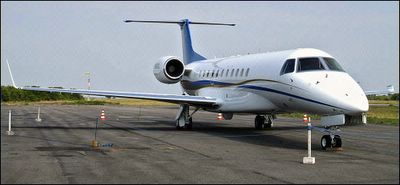
Lo miro y no lo creo. No le veo un solo raspón. ¿Cómo hicieron?
Quizás debí comenzar este post: Como chocar con un Boeing 737 sin dejar huellas.
A ver si Joe Sharkey nos esclarece esta duda.
Chocar chocar... la palabra me parece demasiado grande.
Relacionado:
Noticia ampliada en yahoo y más fotos
Noticia en Folha, inundado de elecciones, pero ahí esta el avión pintando su nota.
Una cosa más, en los comments del blog de Joe se ha iniciado una discusión sobre la retención de los pilotos. Joe Sharkey no comprende porque los han retenido. Si hubiera sucedido en gringolandia, temen los comentaristas, los halcones ya estarían torturando a los pilotos del jet.
Actualización 3 de octubre:

Un fotógrafo con más tino nos despeja la duda. La columna de Joe Sharkey, en el NYT.
SÃO JOSE DOS CAMPOS, Brazil, Oct. 1 — It had been an uneventful, comfortable flight.
With the window shade drawn, I was relaxing in my leather seat aboard a $25 million corporate jet that was flying 37,000 feet above the vast Amazon rainforest. The 7 of us on board the 13-passenger jet were keeping to ourselves.
Without warning, I felt a terrific jolt and heard a loud bang, followed by an eerie silence, save for the hum of the engines.
And then the three words I will never forget. “We’ve been hit,” said Henry Yandle, a fellow passenger standing in the aisle near the cockpit of the Embraer Legacy 600 jet.
“Hit? By what?” I wondered. I lifted the shade. The sky was clear; the sun low in the sky. The rainforest went on forever. But there, at the end of the wing, was a jagged ridge, perhaps a foot high, where the five-foot-tall winglet was supposed to be.
And so began the most harrowing 30 minutes of my life. I would be told time and again in the next few days that nobody ever survives a midair collision. I was lucky to be alive — and only later would I learn that the 155 people aboard the Boeing 737 on a domestic flight that seems to have clipped us were not.
Investigators are still trying to sort out what happened, and how — our smaller jet managed to stay aloft while a 737 that is longer, wider and more than three times as heavy, fell from the sky nose first.
But at 3:59 last Friday afternoon, all I could see, all I knew, was that part of the wing was gone. And it was clear that the situation was worsening in a hurry. The leading edge of the wing was losing rivets, and starting to peel back.
Amazingly, no one panicked. The pilots calmly starting scanning their controls and maps for signs of a nearby airport, or, out their window, a place to come down.
But as the minutes passed, the plane kept losing speed. By now we all knew how bad this was. I wondered how badly ditching — an optimistic term for crashing — was going to hurt.
I thought of my family. There was no point reaching for my cellphone to try a call — there was no signal. And as our hopes sank with the sun, some of us jotted notes to spouses and loved ones and placed them in our wallets, hoping the notes would later be found.
I was focused on a different set of notes when the flight began. I’ve contributed the “On the Road”column for The New York Times business-travel section every week for the last seven years. But I was on the Embraer 600 for a freelance assignment for Business Jet Traveler magazine.
My fellow passengers included executives from Embraer and a charter company called ExcelAire, the new owner of the jet. David Rimmer, the senior vice president of Excel Aire, had invited me to ride home on the jet his company had just taken possession of at Embraer’s headquarters here.
And it had been a nice ride. Minutes before we were hit, I had wandered up to the cockpit to chat with the pilots, who said the plane was flying beautifully. I saw the readout that showed our altitude: 37,000 feet.
I returned to my seat. Minutes later came the strike (it sheared off part of the plane’s tail, too, we later learned).
Immediately afterward, there wasn’t much conversation.
Mr. Rimmer, a large man, was hunched in the aisle in front of me staring out the window at the newly damaged wing.
“How bad is it?” I asked.
He fixed me with a steady look and said, "I don’t know."
I saw the body language of the two pilots. They were like infantrymen working together in a jam, just as they had been trained to do.
For the next 25 minutes, the pilots, Joe Lepore and Jan Paladino, were scanning their instruments, looking for an airport. Nothing turned up.
They sent out a Mayday signal, which was acknowledged by a cargo plane somewhere in the region. There had been no contact with any other plane, and certainly not with a 737 in the same airspace.
Mr. Lepore then spotted a runway through the darkening canopy of trees.
“I can see an airport,” he said.
They tried to contact the control tower at what turned out to be a military base hidden deep in the Amazon. They steered the plane through a big wide sweep to avoid putting too much stress on the wing.
As they approached the runway, they had the first contact with air traffic control.
“We didn’t know how much runway we had or what was on it,” Mr. Paladino would say later that night at the base in the jungle at Cachimbo.
We came down hard and fast. I watched the pilots wrestle the aircraft because so many of their automatic controls were blown. They brought us to a halt with plenty of runway left. We staggered to the exit.
“Nice flying,” I told the pilots as I passed them. Actually, I inserted an unprintable word between “nice” and “flying.”
“Any time,” Mr. Paladino, said with an anxious smile.
Later that night they gave us cold beer and food at the military base. We speculated endlessly about what had caused the impact. A wayward weather balloon? A hot-dogging military fighter jet whose pilot had bailed? An airliner somewhere nearby that had blown up, and rained debris on us?
Later that night they gave us cold beer and food at the military base. We speculated endlessly about what had caused the impact. A wayward weather balloon? A hot-dogging military fighter jet whose pilot had bailed? An airliner somewhere nearby that had blown up, and rained debris on us?
Después de varios días del aterrizaje forzoso del Legacy, por fin, la Fuerza aérea brasileña se ha animado a publicar la foto del aparatito de marras.
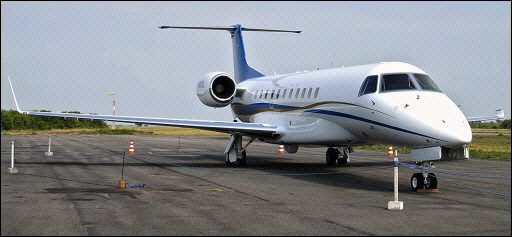
Lo miro y no lo creo. No le veo un solo raspón. ¿Cómo hicieron?
Quizás debí comenzar este post: Como chocar con un Boeing 737 sin dejar huellas.
A ver si Joe Sharkey nos esclarece esta duda.
Chocar chocar... la palabra me parece demasiado grande.
Relacionado:
Noticia ampliada en yahoo y más fotos
Noticia en Folha, inundado de elecciones, pero ahí esta el avión pintando su nota.
Una cosa más, en los comments del blog de Joe se ha iniciado una discusión sobre la retención de los pilotos. Joe Sharkey no comprende porque los han retenido. Si hubiera sucedido en gringolandia, temen los comentaristas, los halcones ya estarían torturando a los pilotos del jet.
Actualización 3 de octubre:

Un fotógrafo con más tino nos despeja la duda. La columna de Joe Sharkey, en el NYT.
SÃO JOSE DOS CAMPOS, Brazil, Oct. 1 — It had been an uneventful, comfortable flight.
With the window shade drawn, I was relaxing in my leather seat aboard a $25 million corporate jet that was flying 37,000 feet above the vast Amazon rainforest. The 7 of us on board the 13-passenger jet were keeping to ourselves.
Without warning, I felt a terrific jolt and heard a loud bang, followed by an eerie silence, save for the hum of the engines.
And then the three words I will never forget. “We’ve been hit,” said Henry Yandle, a fellow passenger standing in the aisle near the cockpit of the Embraer Legacy 600 jet.
“Hit? By what?” I wondered. I lifted the shade. The sky was clear; the sun low in the sky. The rainforest went on forever. But there, at the end of the wing, was a jagged ridge, perhaps a foot high, where the five-foot-tall winglet was supposed to be.
And so began the most harrowing 30 minutes of my life. I would be told time and again in the next few days that nobody ever survives a midair collision. I was lucky to be alive — and only later would I learn that the 155 people aboard the Boeing 737 on a domestic flight that seems to have clipped us were not.
Investigators are still trying to sort out what happened, and how — our smaller jet managed to stay aloft while a 737 that is longer, wider and more than three times as heavy, fell from the sky nose first.
But at 3:59 last Friday afternoon, all I could see, all I knew, was that part of the wing was gone. And it was clear that the situation was worsening in a hurry. The leading edge of the wing was losing rivets, and starting to peel back.
Amazingly, no one panicked. The pilots calmly starting scanning their controls and maps for signs of a nearby airport, or, out their window, a place to come down.
But as the minutes passed, the plane kept losing speed. By now we all knew how bad this was. I wondered how badly ditching — an optimistic term for crashing — was going to hurt.
I thought of my family. There was no point reaching for my cellphone to try a call — there was no signal. And as our hopes sank with the sun, some of us jotted notes to spouses and loved ones and placed them in our wallets, hoping the notes would later be found.
I was focused on a different set of notes when the flight began. I’ve contributed the “On the Road”column for The New York Times business-travel section every week for the last seven years. But I was on the Embraer 600 for a freelance assignment for Business Jet Traveler magazine.
My fellow passengers included executives from Embraer and a charter company called ExcelAire, the new owner of the jet. David Rimmer, the senior vice president of Excel Aire, had invited me to ride home on the jet his company had just taken possession of at Embraer’s headquarters here.
And it had been a nice ride. Minutes before we were hit, I had wandered up to the cockpit to chat with the pilots, who said the plane was flying beautifully. I saw the readout that showed our altitude: 37,000 feet.
I returned to my seat. Minutes later came the strike (it sheared off part of the plane’s tail, too, we later learned).
Immediately afterward, there wasn’t much conversation.
Mr. Rimmer, a large man, was hunched in the aisle in front of me staring out the window at the newly damaged wing.
“How bad is it?” I asked.
He fixed me with a steady look and said, "I don’t know."
I saw the body language of the two pilots. They were like infantrymen working together in a jam, just as they had been trained to do.
For the next 25 minutes, the pilots, Joe Lepore and Jan Paladino, were scanning their instruments, looking for an airport. Nothing turned up.
They sent out a Mayday signal, which was acknowledged by a cargo plane somewhere in the region. There had been no contact with any other plane, and certainly not with a 737 in the same airspace.
Mr. Lepore then spotted a runway through the darkening canopy of trees.
“I can see an airport,” he said.
They tried to contact the control tower at what turned out to be a military base hidden deep in the Amazon. They steered the plane through a big wide sweep to avoid putting too much stress on the wing.
As they approached the runway, they had the first contact with air traffic control.
“We didn’t know how much runway we had or what was on it,” Mr. Paladino would say later that night at the base in the jungle at Cachimbo.
We came down hard and fast. I watched the pilots wrestle the aircraft because so many of their automatic controls were blown. They brought us to a halt with plenty of runway left. We staggered to the exit.
“Nice flying,” I told the pilots as I passed them. Actually, I inserted an unprintable word between “nice” and “flying.”
“Any time,” Mr. Paladino, said with an anxious smile.
Later that night they gave us cold beer and food at the military base. We speculated endlessly about what had caused the impact. A wayward weather balloon? A hot-dogging military fighter jet whose pilot had bailed? An airliner somewhere nearby that had blown up, and rained debris on us?
Later that night they gave us cold beer and food at the military base. We speculated endlessly about what had caused the impact. A wayward weather balloon? A hot-dogging military fighter jet whose pilot had bailed? An airliner somewhere nearby that had blown up, and rained debris on us?
martes, septiembre 26, 2006
domingo, septiembre 24, 2006
jueves, septiembre 21, 2006
Periodismo culural...algunas lecturas...
Periodismo Cultural en México (¿y latinoamérica?)
Dando hoy otra vuelta por la Facultad de ciencias y artes de la comunicación encontré en un panel una nota sobre periodismo cultural:
Periodismo Cultural
¿Qué pasa cuando Salamanca ya non presta? Gabriel Zaid anota las razones del lamentable estado de nuestro periodismo cultural y propone una solución pragmática que cimiente la lenta solución que pide el problema: el ejercicio de la verificación de datos, regular en otras tradiciones.
Lea e imprima el artículo completo aquí: Periodismo Cultural por Gabriel Zaid
Del mismo autor encontré este texto:
Organizados para no leer por Gabriel Zaid
"Existe una enorme diferencia entre leer y leer. El lector clásico, que iba de tapa a tapa, tomaba notas y enviaba largas reseñas a los periódicos, ahora ha cedido su lugar al lector de solapas, de sinopsis y mini-señas, e incluso al lector que no lee. En este ensayo Zaid traza algunos hitos de la metamorfosis."
Lea el artículo completo aquí: Organizados para no leer por Gabriel Zaid
Además un enlace al blog del periodista Héctor Feliciano
Blog de Héctor Feliciano / Periodista Cultural
Y una entrevista a Héctor Feliciano publicada en nuestro diario oficial, sobre periodismo cultural:
La investigación, ese olvido del periodismo cultural
Dando hoy otra vuelta por la Facultad de ciencias y artes de la comunicación encontré en un panel una nota sobre periodismo cultural:
Periodismo Cultural
¿Qué pasa cuando Salamanca ya non presta? Gabriel Zaid anota las razones del lamentable estado de nuestro periodismo cultural y propone una solución pragmática que cimiente la lenta solución que pide el problema: el ejercicio de la verificación de datos, regular en otras tradiciones.
Lea e imprima el artículo completo aquí: Periodismo Cultural por Gabriel Zaid
Del mismo autor encontré este texto:
Organizados para no leer por Gabriel Zaid
"Existe una enorme diferencia entre leer y leer. El lector clásico, que iba de tapa a tapa, tomaba notas y enviaba largas reseñas a los periódicos, ahora ha cedido su lugar al lector de solapas, de sinopsis y mini-señas, e incluso al lector que no lee. En este ensayo Zaid traza algunos hitos de la metamorfosis."
Lea el artículo completo aquí: Organizados para no leer por Gabriel Zaid
Además un enlace al blog del periodista Héctor Feliciano
Blog de Héctor Feliciano / Periodista Cultural
Y una entrevista a Héctor Feliciano publicada en nuestro diario oficial, sobre periodismo cultural:
La investigación, ese olvido del periodismo cultural
miércoles, septiembre 13, 2006
FE PUCP: TRABAJO PARA BLANCOS
Hoy estuve dando vueltas por la pucp, no buscaba la laptop de Mockus ni nada por el estilo. Solo transitaba por ahí.

El llamado "tontódromo" o avenida principal estaba decorado por ocasionales avisos sobre el "Encuentro de derechos humanos".

Y entre el comedor central y la facultad de derecho se ha abierto una feria con ONGs de derechos humanos.
Sin embargo, cerca a la biblioteca central había un panel con anuncios y encontré un pedido singular.


Uds. contrastarán con otro anuncio que decía:

Acaso no contrasta ese papa noel con el llamado a la inclusión de su periódico estrella que ahora se ufana de distribuirse en "los cafés Delicass y San Antonio , así como en el Club Las Terrazas de Miraflores".

¿Alguna vez será de distribución en las unidades escolares estatales? ¿Llegará un numerito a algún comedor popular?

¿Y un papanoel más inclusivo?
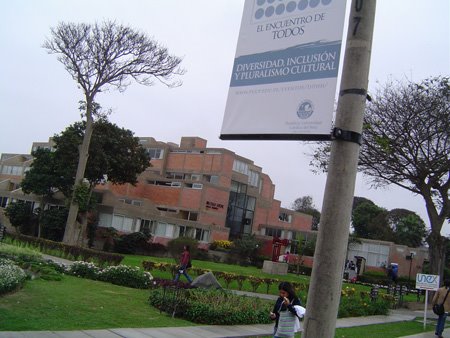
El llamado "tontódromo" o avenida principal estaba decorado por ocasionales avisos sobre el "Encuentro de derechos humanos".
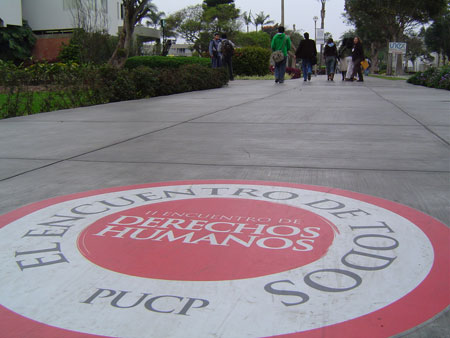
Y entre el comedor central y la facultad de derecho se ha abierto una feria con ONGs de derechos humanos.
Sin embargo, cerca a la biblioteca central había un panel con anuncios y encontré un pedido singular.

Uds. contrastarán con otro anuncio que decía:

Acaso no contrasta ese papa noel con el llamado a la inclusión de su periódico estrella que ahora se ufana de distribuirse en "los cafés Delicass y San Antonio , así como en el Club Las Terrazas de Miraflores".

¿Alguna vez será de distribución en las unidades escolares estatales? ¿Llegará un numerito a algún comedor popular?
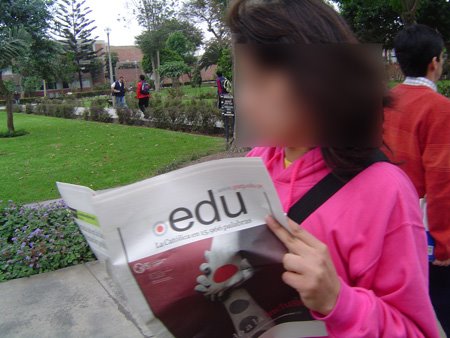
¿Y un papanoel más inclusivo?
sábado, septiembre 09, 2006
Esterilización forzada en inglés.../ forced sterilisation
Este es un artículo del Le Monde Diplomatique, sobre las prácticas del gobierno fujimorista contra la población peruana:
’REDUCING THE NUMBER OF BIRTHS PER WOMAN TO REDUCE POVERTY MADE MATHEMATICAL SENSE TO FUJIMORI. ANY METHOD OF BALANCING THE EQUATION WAS VALID’
Peru: the scandal of forced sterilisation
Peru’s government wants to extradite former President Alberto Fujimori from sanctuary in Japan in connection with assassinations in the 1990s. But his government’s eugenic policy, which encouraged the sterilisation of 300,000 women from poor Amerindian communities, has not been mentioned
By Françoise Barthélémy
HALLYCOCHA is an Amerindian community in Laguna Pampa in the Andean uplands, 50 kilometres from Cuzco, Peru. Here farmers till the land using ox-drawn ploughs. In one of the ramshackle houses lives Hilaria Supa Huamán, her hands deformed by arthritis; she has just come back from her chacra, the small plot where she grows corn, maize and potatoes.
In 1991 Hilaria was one of the founders of the women’s Peasant Federation of Anta, which is a largely rural province with about 80,000 inhabitants. Three years later she became its secretary-general and in that capacity took part in the 1995 IVth World Conference on Women in Beijing. That gave her the opportunity to speak to President Albert Fujimori. "He began talking to me about a family planning health care programme he wanted to launch. I said: ’Fine, provided husbands and wives take decisions jointly.’ ’Of course,’ he said."
Some months later, under strong pressure from the village nurse and without any detailed information, Hilaria had tubal ligation surgery and found it hard to recover. "They insult you by saying: ’Do you want to breed like a pig? Your husband will be angry if you do nothing,’" she says. "Afterwards they assure you that you will soon be back on your feet. That’s not true. The scar outside heals, but internally healing is slow because our work is so physically demanding."
She is not alone is suffering side-effects. Her friend who lives in Mollepata says that she too is "very much weakened" after tubal ligation. Disturbing facts have emerged from several communities including Mollepata, Limatambo and Ancahuasi. It was claimed that women visiting the dispensary for health checks for their children were locked in, sometimes in groups of 10 or 20. They were told they were to be vaccinated and then taken individually to the operating theatre and anaesthetised. They came out feeling groggy. Later they realised they had been sterilised.
Hilaria, with others, decided to make public what was happening. She and her colleagues were consequently excluded from the leadership of the Peasant Federation. They claim that the reprisals were the work of a gynaecologist, Washington Ortiz, who had pressurised patients who had had surgery to withdraw complaints.
The protest movement has swelled. "At communal and regional level, our council condemns the practice of forced sterilisation," says Rosas Beltrán, mayor of Anta and director of the Peruvian Network of Rural Councils (1). "With the Cuzco public prosecutor’s office (2), we organised opposition and aid for the victims."
The health minister, Luis Solari, set up a special commission on the activities of the voluntary surgical contraception programme (AQV) on 8 September 2001, less than a year after Fujimori had been deposed by the Peruvian Congress and fled to Japan. Solari entrusted four people, including Hilaria Supa Huamán, with the investigation. Also in September 2001 the Congress appointed a commission to look into irregularities committed in the AQV programme under Fujimori; its head was Hector Chávez Cuchón, a Congress member and president of the Federation of Doctors for the Ayacucho, Andahuaylas and Huancavelica region.
In July 2002 the investigators appointed by the health ministry (Minsa) published their 137-page report which revealed that 331,600 women had been sterilised and 25,590 men had had vasectomies between 1995 and 2001, stressing that they were blackmailed, threatened, or bribed with food; none was properly informed.This had been done in the name of a public health programme with the real aim of cutting the birth rate in the poorest regions; its main victims were Amerindian people from under-privileged areas: the Andean sierra, the Amazon selva (forest) and shantytowns around Lima.
Many official documents had been destroyed but 56 survived to show what had happened and who was responsible. Fujimori had the prime responsibility; he had been given monthly updates about the number of operations by the offices of former health ministers Eduardo Yong Motta (1994-96), Marino Costa Bauer (1996-99) and Alejandro Aguinaga (1999-2000). As soon as the report was published, there was a heated debate about the programme’s statistics and real objective. Alejandro Aguinaga, however, vigorously defended a plan which, he claimed, had allowed hundreds of thousands of couples to avoid unwanted pregnancies or abortions and conspicuously reduced mortality rates for mothers and babies.
Former minister Bauer cited (in La Républica on 25 July 2002) an inquiry undertaken by a United States agency between 1996 and 2000 in support of his claim that "90% of women of child-bearing age are completely satisfied with the family planning methods made available to them". But on the same page of the newspaper a woman called Ligia Rios explained how members of the Peruvian Institute of Social Security (IPSS) harassed her until she agreed to be sterilised. After the operation she had fever, bleeding and abdom inal pain and had been forced to give up work.
When Minsa’s final report was submitted to the Peruvian Congress in July 2002, its members decided to charge Fujimori and his three former health ministers with "genocide" and "crimes against humanity". A year later the congressional commission on human rights, chaired by parliamentarian Dora Nuñez (Moralising Independent Front) took up the charges and called for an investigation by the public prosecutor. The congressional standing committee rejected the proposal. The debate got bogged down in committees.
Fujimori responded from Tokyo, where he had been living since the Japanese government gave him Japanese nationality, sheltering him from possible extradition. He claimed that he had not approved forced sterilisation: rather that, for the first time in their history, Peruvian women had been given the opportunity to opt for responsible motherhood.
Peruvian and foreign researchers have been trying to establish the facts (2). Mandated by the committee for the defence of women’s rights in Latin America, lawyer and sociologist Giulia Tamayo has collected evidence from about 100 women from Lima, Cuzco, Loreto, Piura and San Martín. Her report (published 22 June 1998 by El Commercio, Lima’s biggest selling daily) cited abusive practices, failure to obtain prior consent and post-operative complications. There were deaths because of negligence, poor hygiene, inadequate training of personnel, the poor health of patients (tuberculosis or malnutrition) or even as a result of an undetected pregnancy. In 1999 a related book was published linked to a video documentary, Nada personal (Nothing Personal), which dramatically revealed that what had at first appeared from the government’s point of view to be objectives to be achieved in sterilisation had soon turned into forced quotas that had to be met by health professionals and establishments. A good performance brought rewards. Poor performances brought penalties. Nada personal described a coldly devised government programme; its author was threatened and intimidated. The Peruvian authorities of the time have never acknowledged the existence of quotas. Everybody keeps silent. But it is undeniable that there was an extraordinary increase in "voluntary" surgical contraception: tubal ligations went up from 81,762 in 1996 to 109,689 in 1997. In 1998 numbers fell to 25,995.
Arequipa, known as Ciudad Blanca, the white city, is 2,300m above sea level in the western Andes. It has a long tradition of social struggle and anti-authoritanarianism and its citizens challenged the Fujimori regime. Juan Manuel Guillén, a former rector of the university, was its mayor until 2003 and helped organise the vigorous protests that forced the current president, Alejandro Toledo, to abandon the idea of privatising two electricity companies. Guillén says: "There is a close relationship between the neoliberal policy imposed on Peru by the International Monetary Fund and the World Bank and the family planning programme engineered by Fujimori. In exchange for loans and the renegotiation of Peru’s debt, the IMF demanded privatisation, including the health sector, and opening up to investment. But it also wanted control of population growth, where the target was the poor or very poor and potentially dangerous sectors. That violated individual rights and the rights of families, and the moral principles that should underpin society."
Fujimori skilfully presented the reproductive health programme, saying on 28 July 1995 that the state would give low-income and poorly educated families access to methods of family planning available to the better off. He ended his speech with: "We have been and will be a pragmatic government without taboos or sacred cows. Peruvian women should be in charge of their own destiny."
The Peruvian exchequer alone did not fund the project: the US Agency for International Development (Usaid) was the main source of technical and financial assistance, contributing $36m, seven times more than the second largest donor, the United Nations Population Fund. Usaid was given the go-ahead by a US Congress that had a Repub lican majority traditionally opposed to birth control programmes; but Congress was focusing on domestic issues at the time, particularly its opposition to President Bill Clinton. There was also $2m from Nippon Zaidan, a Japanese foundation whose president Ayako Sono is said to be one of Fujimori’s main protectors.
NGOs including the American Pathfinder organisation received funds, as did the Peruvian feminist organisation Manuela Ramos (3). With the militants from the Flora Tristán Peruvian Women’s Centre, they had been fighting for women since the 1970s and did not conceal their enthusiasm at a longed-for opportunity to demolish the "retrograde" positions of the Catholic Church, which some members believed were linked to Opus Dei. The church hierarchy did indeed immediately challenge the decision to promote artificial methods of birth control and introduce sex education in schools. When alerted to forced sterilisations, feminist NGOs identified the danger that conservative sectors in society would try to destroy the family planning programme. Although they condemned individual case "mistakes", these NGOs felt they had to back a governmental strategy supported by major international bodies.
In 1995 Fujimori was re-elected with 64% of the vote, his image enhanced by the victory over the Shining Path guerrillas. There had been his self- inflicted coup of 5 April 1992 when Congress was dissolved and the judiciary reined in; and there had been the "fujishock" of ultraliberal measures, projected as a necessary adjustment. "That was when Fujimori began taking radical decisions on the taboo that is birth control," says Raul Wiener, political analyst and co-ordinator of opposition to the Free Trade Area of the Americas. "As a good mathematician, Fujimori was fascinated by figures. Reducing the number of births per woman to reduce poverty made mathematical sense to him. Any method of balancing the equation was valid, including the most brutal approach."
Fujimori tabled a bill on 9 September 1995 amending the General Population Law to permit the use of sterilisation (4). Congress approved a law that made sterilisation as legal as contraceptive injections, pills, diaphragms and sheaths. It was important that sterilisation was to be free. There was a rush of enthusiasm in all the ministries - headed by the new ministry for the promotion of women and human development - and in the armed forces and the national police.
Doctors, engaged for renewable periods of three months, were no longer given the option of objecting on grounds of conscience. Sterilisation festivals were organised in the country and pueblos jóvenes (shantytowns); days of games, dancing, concerts, theatre, puppet shows, fireworks, sport, plenty of food and free dentists and hairdressers. Posters showed modern families with few children and backward families with many ragged kids. Notices in Spanish offered tubal ligations and vasectomies, free of charge. By the time the festivities were over, the urban doctors had done a lot of work. But what did Quechua-speaking and mostly illiterate women understand of the information or letters of consent they had to sign? "Women doctors, nurses and nursing auxiliaries chatted with the women in the local dispensary and won them over with oil, corn, sugar and rice," according to a tourist guide at Machu Picchu, who trained at the Central University of San Antonio Abat in Cuzco. "All of that coincided with the government’s implementation of food aid programmes and infrastructure projects in out-of-the-way places. Fujimori, wearing a poncho, climbing out of a helicopter and filmed by television, turned up to inaugurate his projects. He was adored. They called him Chino Bueno."
Those circumstances explain to some extent the cautious approach of serious newspapers such as La Republica or El Commercio. Outside Peru the World Health Organisation fulsomely praised Peru’s family planning successes (5). Inside Peru accusations of possible abuses came from the Catholic Church. But were they well-founded?
Not until 1996 did a journalist from El Commercio, Julia Maria Urrunaga, take an interest in what was happening in remote areas. She heard a sad story from Tocache, a small village in the Amazonian forest, and travelled there to find out how a young mother had died. This woman had been immediately discharged after sterilisation in hospital, and sent home by motorbike, a 20-minute journey jolting along a dirt track. An infection developed. She died.
Urrunaga went to the house and met women neighbours trembling with fear. They had had the same operation and now their angry husbands were calling them putas (whores). "I saw the dead woman’s two children," says Urrunaga, " They were front page news and the report disclosed what had been hushed up." Trade unions, women’s groups, opposition members of parliament including Beatriz Merino, and Catholics were mobilised. But predominantly urban society took little notice. Urrunaga says they care even less now. "With the social problems and the crisis Peruvians are facing, it’s everyone for himself, plus a deep-seated disenchantment with the leadership."
In 1992 Dr Ramón Figueroa was a surgeon in the public health sector in Cuzco, that living museum of Inca civilisation, 3,400m up in the Andes cordillera. For a few months he was also director of the regional hospital. After 1996, with other colleagues working through the Association of Doctors, he denounced the sterilisation campaigns, stressing their racist nature. "The atmosphere was tense. Tackling an authoritarian and repressive government, with the corruption it fostered, left us open to serious threats," says Figueroa, currently an activist in the Democratic Decentralist party. "We were called agents of subversion. Gradually that inhumane policy was more or less abandoned by the government, yet without any self-criticism."
Fernando Robles Callomanay, of Aymara origin, has been the mayor of Ilave, the second largest town in the Puno region, for two years. He says: "The government of the time had a policy of ethnic cleansing, attacking the Amerindians and not whites or creoles. The consequences affect several aspects of economic and social life, in particular demographics." The birth rate has fallen sharply; schools and colleges are empty. It will be necessary to amalgamate them and some will disappear because of a lack of students. Most campesinas who underwent the operation suffer from complaints such as sickness and depression. "They are disapproved of by family and friends. The few men who have had vasectomies are taunted as eunuchs."
In the US there was, albeit belated, indignation, particularly after the Population Research Institute sent its representative, David Morrison, to Peru with a film crew; in January 1998 he published a report that generated sufficient interest in the US Congress for public hearings to be organised, during which victims told their stories. The public prosecutor’s office in Lima investigated complaints and accusations.
That led the US Congress to review the aid earmarked for family planning programmes and on 22 October 1998 the Tiahrt amendment (6) regu lating the use of Usaid funds accorded to Peru and other countries was adopted. Either beneficiaries complied with strict conditions or they received no more aid. There were commendable warnings about respect for human rights. But, after a second mission in December 1999 to Ayacucho and Huánuco, Morrison revealed that coercion, mis information, threats and scheming continued. He denounced Usaid’s failure to stop sending money to the Peruvian government, even though that funding was now illegal (7).
Since then rules governing sterilisation have been reviewed and amended along with all aspects of birth control policy. Reactionary movements within the church are influencing political life. Luis Solari, a doctor with a degree from San Marcos University, is the number two in Perú Posible, President Toledo’s party. He is a member of the department for the protection of life of the Peruvian Episcopal Assembly and describes himself as a man of faith. On becoming health minister in 2001, he created the special commission that published the final report on forced sterilisation.
"By doing that, he rejected the early investigations, particularly those that placed women’s freedom at the heart of the issue, and imposed his own conservative views," says Roxana Vásquez, a lawyer and director of the NGO Office for the Defence of Women’s Rights. "What is our main concern? That women’s rights should be guaranteed. Abortion is banned, a criminal offence. A middle-class woman can have an abortion without risk. Those who die, more than 350,000 a year, because they have had to use needles, are the poor. Luis Solari and his successor as health minister, Fernando Carbone, were and still are opposed to the use of contraception."
Although the new health minister, Pilar Elena Mazzeti, is more open-minded, nothing can be taken for granted. The Truth and Reconciliation Commission (CVR) is calling for changes; it has tried to summarise and analyse the causes of political violence over the past 20 years. According to its final report of 28 August 2003, the conflict has brought to light the "enormous social divides that have existed and still exist in Peruvian society" and "the link between poverty and exclusion and the likelihood of falling victim to violence". Victims are mostly Quecha-speakers from the poorest provinces, "insignificant" people whose fate is of no interest to the rest of the country.
Salomón Lerner Febres, rector of the Catholic University of Peru and CVR president, believes that this tragedy has much in common with the women who have undergone forced sterilisation. "But they are no longer seen as a matter of concern. In this terrible story ideology has blurred the picture; the stubbornness of the feminists, the great eagerness of Opus Dei to get hold of the case and the impudence of political leaders relying on ignorance and indifference. In my university we are going to set up an institute for human rights and democracy. And we will be taking up the issue of mass sterilisation again."
(1) Founded in Lima in January 2000, the organisation was strengthened by its later amalgamation with the Network of Alternative Municipalities. It is supported by international technical cooperation agencies from France and the United Kingdom. See: Remurpe website
(2) See the study by Peruvian public health consultant Raquel Hurtado, Aplicación de la anticonceptión quirúrgica como política de población en el Perú y violaciones a los Derechos humanos, Lima 2000. See also the book written by Maria-Christine Zauzich published by the German Justice and Peace Commission, Munich, 2000.
(3) It is estimated that the Peruvian NGO Reprosalud Manuela Ramos received $25m from Usaid 1995-2000.
(4) The 1985 Law on Population Policy prohibited surgical sterilisation. A national population council was mandated to monitor compliance but will be replaced by Promudeh.
(5) At an international seminar in 1996 on the reform of the health sector, Fujimori’s opening speech was fully endorsed by both the WHO and the Pan American Health Organisation.
(6) The amendment is named after its main backer, Todd Tiarhrt, a Republican member of Congress from Kansas.
(7) See David Morrison, A pesar de abusos comprobables, la Usaid sigue financiando programas de planificación familiar en Perù, Population Research Institute review, Front Royal, Virginia, January-February 2000.
’REDUCING THE NUMBER OF BIRTHS PER WOMAN TO REDUCE POVERTY MADE MATHEMATICAL SENSE TO FUJIMORI. ANY METHOD OF BALANCING THE EQUATION WAS VALID’
Peru: the scandal of forced sterilisation
Peru’s government wants to extradite former President Alberto Fujimori from sanctuary in Japan in connection with assassinations in the 1990s. But his government’s eugenic policy, which encouraged the sterilisation of 300,000 women from poor Amerindian communities, has not been mentioned
By Françoise Barthélémy
HALLYCOCHA is an Amerindian community in Laguna Pampa in the Andean uplands, 50 kilometres from Cuzco, Peru. Here farmers till the land using ox-drawn ploughs. In one of the ramshackle houses lives Hilaria Supa Huamán, her hands deformed by arthritis; she has just come back from her chacra, the small plot where she grows corn, maize and potatoes.
In 1991 Hilaria was one of the founders of the women’s Peasant Federation of Anta, which is a largely rural province with about 80,000 inhabitants. Three years later she became its secretary-general and in that capacity took part in the 1995 IVth World Conference on Women in Beijing. That gave her the opportunity to speak to President Albert Fujimori. "He began talking to me about a family planning health care programme he wanted to launch. I said: ’Fine, provided husbands and wives take decisions jointly.’ ’Of course,’ he said."
Some months later, under strong pressure from the village nurse and without any detailed information, Hilaria had tubal ligation surgery and found it hard to recover. "They insult you by saying: ’Do you want to breed like a pig? Your husband will be angry if you do nothing,’" she says. "Afterwards they assure you that you will soon be back on your feet. That’s not true. The scar outside heals, but internally healing is slow because our work is so physically demanding."
She is not alone is suffering side-effects. Her friend who lives in Mollepata says that she too is "very much weakened" after tubal ligation. Disturbing facts have emerged from several communities including Mollepata, Limatambo and Ancahuasi. It was claimed that women visiting the dispensary for health checks for their children were locked in, sometimes in groups of 10 or 20. They were told they were to be vaccinated and then taken individually to the operating theatre and anaesthetised. They came out feeling groggy. Later they realised they had been sterilised.
Hilaria, with others, decided to make public what was happening. She and her colleagues were consequently excluded from the leadership of the Peasant Federation. They claim that the reprisals were the work of a gynaecologist, Washington Ortiz, who had pressurised patients who had had surgery to withdraw complaints.
The protest movement has swelled. "At communal and regional level, our council condemns the practice of forced sterilisation," says Rosas Beltrán, mayor of Anta and director of the Peruvian Network of Rural Councils (1). "With the Cuzco public prosecutor’s office (2), we organised opposition and aid for the victims."
The health minister, Luis Solari, set up a special commission on the activities of the voluntary surgical contraception programme (AQV) on 8 September 2001, less than a year after Fujimori had been deposed by the Peruvian Congress and fled to Japan. Solari entrusted four people, including Hilaria Supa Huamán, with the investigation. Also in September 2001 the Congress appointed a commission to look into irregularities committed in the AQV programme under Fujimori; its head was Hector Chávez Cuchón, a Congress member and president of the Federation of Doctors for the Ayacucho, Andahuaylas and Huancavelica region.
In July 2002 the investigators appointed by the health ministry (Minsa) published their 137-page report which revealed that 331,600 women had been sterilised and 25,590 men had had vasectomies between 1995 and 2001, stressing that they were blackmailed, threatened, or bribed with food; none was properly informed.This had been done in the name of a public health programme with the real aim of cutting the birth rate in the poorest regions; its main victims were Amerindian people from under-privileged areas: the Andean sierra, the Amazon selva (forest) and shantytowns around Lima.
Many official documents had been destroyed but 56 survived to show what had happened and who was responsible. Fujimori had the prime responsibility; he had been given monthly updates about the number of operations by the offices of former health ministers Eduardo Yong Motta (1994-96), Marino Costa Bauer (1996-99) and Alejandro Aguinaga (1999-2000). As soon as the report was published, there was a heated debate about the programme’s statistics and real objective. Alejandro Aguinaga, however, vigorously defended a plan which, he claimed, had allowed hundreds of thousands of couples to avoid unwanted pregnancies or abortions and conspicuously reduced mortality rates for mothers and babies.
Former minister Bauer cited (in La Républica on 25 July 2002) an inquiry undertaken by a United States agency between 1996 and 2000 in support of his claim that "90% of women of child-bearing age are completely satisfied with the family planning methods made available to them". But on the same page of the newspaper a woman called Ligia Rios explained how members of the Peruvian Institute of Social Security (IPSS) harassed her until she agreed to be sterilised. After the operation she had fever, bleeding and abdom inal pain and had been forced to give up work.
When Minsa’s final report was submitted to the Peruvian Congress in July 2002, its members decided to charge Fujimori and his three former health ministers with "genocide" and "crimes against humanity". A year later the congressional commission on human rights, chaired by parliamentarian Dora Nuñez (Moralising Independent Front) took up the charges and called for an investigation by the public prosecutor. The congressional standing committee rejected the proposal. The debate got bogged down in committees.
Fujimori responded from Tokyo, where he had been living since the Japanese government gave him Japanese nationality, sheltering him from possible extradition. He claimed that he had not approved forced sterilisation: rather that, for the first time in their history, Peruvian women had been given the opportunity to opt for responsible motherhood.
Peruvian and foreign researchers have been trying to establish the facts (2). Mandated by the committee for the defence of women’s rights in Latin America, lawyer and sociologist Giulia Tamayo has collected evidence from about 100 women from Lima, Cuzco, Loreto, Piura and San Martín. Her report (published 22 June 1998 by El Commercio, Lima’s biggest selling daily) cited abusive practices, failure to obtain prior consent and post-operative complications. There were deaths because of negligence, poor hygiene, inadequate training of personnel, the poor health of patients (tuberculosis or malnutrition) or even as a result of an undetected pregnancy. In 1999 a related book was published linked to a video documentary, Nada personal (Nothing Personal), which dramatically revealed that what had at first appeared from the government’s point of view to be objectives to be achieved in sterilisation had soon turned into forced quotas that had to be met by health professionals and establishments. A good performance brought rewards. Poor performances brought penalties. Nada personal described a coldly devised government programme; its author was threatened and intimidated. The Peruvian authorities of the time have never acknowledged the existence of quotas. Everybody keeps silent. But it is undeniable that there was an extraordinary increase in "voluntary" surgical contraception: tubal ligations went up from 81,762 in 1996 to 109,689 in 1997. In 1998 numbers fell to 25,995.
Arequipa, known as Ciudad Blanca, the white city, is 2,300m above sea level in the western Andes. It has a long tradition of social struggle and anti-authoritanarianism and its citizens challenged the Fujimori regime. Juan Manuel Guillén, a former rector of the university, was its mayor until 2003 and helped organise the vigorous protests that forced the current president, Alejandro Toledo, to abandon the idea of privatising two electricity companies. Guillén says: "There is a close relationship between the neoliberal policy imposed on Peru by the International Monetary Fund and the World Bank and the family planning programme engineered by Fujimori. In exchange for loans and the renegotiation of Peru’s debt, the IMF demanded privatisation, including the health sector, and opening up to investment. But it also wanted control of population growth, where the target was the poor or very poor and potentially dangerous sectors. That violated individual rights and the rights of families, and the moral principles that should underpin society."
Fujimori skilfully presented the reproductive health programme, saying on 28 July 1995 that the state would give low-income and poorly educated families access to methods of family planning available to the better off. He ended his speech with: "We have been and will be a pragmatic government without taboos or sacred cows. Peruvian women should be in charge of their own destiny."
The Peruvian exchequer alone did not fund the project: the US Agency for International Development (Usaid) was the main source of technical and financial assistance, contributing $36m, seven times more than the second largest donor, the United Nations Population Fund. Usaid was given the go-ahead by a US Congress that had a Repub lican majority traditionally opposed to birth control programmes; but Congress was focusing on domestic issues at the time, particularly its opposition to President Bill Clinton. There was also $2m from Nippon Zaidan, a Japanese foundation whose president Ayako Sono is said to be one of Fujimori’s main protectors.
NGOs including the American Pathfinder organisation received funds, as did the Peruvian feminist organisation Manuela Ramos (3). With the militants from the Flora Tristán Peruvian Women’s Centre, they had been fighting for women since the 1970s and did not conceal their enthusiasm at a longed-for opportunity to demolish the "retrograde" positions of the Catholic Church, which some members believed were linked to Opus Dei. The church hierarchy did indeed immediately challenge the decision to promote artificial methods of birth control and introduce sex education in schools. When alerted to forced sterilisations, feminist NGOs identified the danger that conservative sectors in society would try to destroy the family planning programme. Although they condemned individual case "mistakes", these NGOs felt they had to back a governmental strategy supported by major international bodies.
In 1995 Fujimori was re-elected with 64% of the vote, his image enhanced by the victory over the Shining Path guerrillas. There had been his self- inflicted coup of 5 April 1992 when Congress was dissolved and the judiciary reined in; and there had been the "fujishock" of ultraliberal measures, projected as a necessary adjustment. "That was when Fujimori began taking radical decisions on the taboo that is birth control," says Raul Wiener, political analyst and co-ordinator of opposition to the Free Trade Area of the Americas. "As a good mathematician, Fujimori was fascinated by figures. Reducing the number of births per woman to reduce poverty made mathematical sense to him. Any method of balancing the equation was valid, including the most brutal approach."
Fujimori tabled a bill on 9 September 1995 amending the General Population Law to permit the use of sterilisation (4). Congress approved a law that made sterilisation as legal as contraceptive injections, pills, diaphragms and sheaths. It was important that sterilisation was to be free. There was a rush of enthusiasm in all the ministries - headed by the new ministry for the promotion of women and human development - and in the armed forces and the national police.
Doctors, engaged for renewable periods of three months, were no longer given the option of objecting on grounds of conscience. Sterilisation festivals were organised in the country and pueblos jóvenes (shantytowns); days of games, dancing, concerts, theatre, puppet shows, fireworks, sport, plenty of food and free dentists and hairdressers. Posters showed modern families with few children and backward families with many ragged kids. Notices in Spanish offered tubal ligations and vasectomies, free of charge. By the time the festivities were over, the urban doctors had done a lot of work. But what did Quechua-speaking and mostly illiterate women understand of the information or letters of consent they had to sign? "Women doctors, nurses and nursing auxiliaries chatted with the women in the local dispensary and won them over with oil, corn, sugar and rice," according to a tourist guide at Machu Picchu, who trained at the Central University of San Antonio Abat in Cuzco. "All of that coincided with the government’s implementation of food aid programmes and infrastructure projects in out-of-the-way places. Fujimori, wearing a poncho, climbing out of a helicopter and filmed by television, turned up to inaugurate his projects. He was adored. They called him Chino Bueno."
Those circumstances explain to some extent the cautious approach of serious newspapers such as La Republica or El Commercio. Outside Peru the World Health Organisation fulsomely praised Peru’s family planning successes (5). Inside Peru accusations of possible abuses came from the Catholic Church. But were they well-founded?
Not until 1996 did a journalist from El Commercio, Julia Maria Urrunaga, take an interest in what was happening in remote areas. She heard a sad story from Tocache, a small village in the Amazonian forest, and travelled there to find out how a young mother had died. This woman had been immediately discharged after sterilisation in hospital, and sent home by motorbike, a 20-minute journey jolting along a dirt track. An infection developed. She died.
Urrunaga went to the house and met women neighbours trembling with fear. They had had the same operation and now their angry husbands were calling them putas (whores). "I saw the dead woman’s two children," says Urrunaga, " They were front page news and the report disclosed what had been hushed up." Trade unions, women’s groups, opposition members of parliament including Beatriz Merino, and Catholics were mobilised. But predominantly urban society took little notice. Urrunaga says they care even less now. "With the social problems and the crisis Peruvians are facing, it’s everyone for himself, plus a deep-seated disenchantment with the leadership."
In 1992 Dr Ramón Figueroa was a surgeon in the public health sector in Cuzco, that living museum of Inca civilisation, 3,400m up in the Andes cordillera. For a few months he was also director of the regional hospital. After 1996, with other colleagues working through the Association of Doctors, he denounced the sterilisation campaigns, stressing their racist nature. "The atmosphere was tense. Tackling an authoritarian and repressive government, with the corruption it fostered, left us open to serious threats," says Figueroa, currently an activist in the Democratic Decentralist party. "We were called agents of subversion. Gradually that inhumane policy was more or less abandoned by the government, yet without any self-criticism."
Fernando Robles Callomanay, of Aymara origin, has been the mayor of Ilave, the second largest town in the Puno region, for two years. He says: "The government of the time had a policy of ethnic cleansing, attacking the Amerindians and not whites or creoles. The consequences affect several aspects of economic and social life, in particular demographics." The birth rate has fallen sharply; schools and colleges are empty. It will be necessary to amalgamate them and some will disappear because of a lack of students. Most campesinas who underwent the operation suffer from complaints such as sickness and depression. "They are disapproved of by family and friends. The few men who have had vasectomies are taunted as eunuchs."
In the US there was, albeit belated, indignation, particularly after the Population Research Institute sent its representative, David Morrison, to Peru with a film crew; in January 1998 he published a report that generated sufficient interest in the US Congress for public hearings to be organised, during which victims told their stories. The public prosecutor’s office in Lima investigated complaints and accusations.
That led the US Congress to review the aid earmarked for family planning programmes and on 22 October 1998 the Tiahrt amendment (6) regu lating the use of Usaid funds accorded to Peru and other countries was adopted. Either beneficiaries complied with strict conditions or they received no more aid. There were commendable warnings about respect for human rights. But, after a second mission in December 1999 to Ayacucho and Huánuco, Morrison revealed that coercion, mis information, threats and scheming continued. He denounced Usaid’s failure to stop sending money to the Peruvian government, even though that funding was now illegal (7).
Since then rules governing sterilisation have been reviewed and amended along with all aspects of birth control policy. Reactionary movements within the church are influencing political life. Luis Solari, a doctor with a degree from San Marcos University, is the number two in Perú Posible, President Toledo’s party. He is a member of the department for the protection of life of the Peruvian Episcopal Assembly and describes himself as a man of faith. On becoming health minister in 2001, he created the special commission that published the final report on forced sterilisation.
"By doing that, he rejected the early investigations, particularly those that placed women’s freedom at the heart of the issue, and imposed his own conservative views," says Roxana Vásquez, a lawyer and director of the NGO Office for the Defence of Women’s Rights. "What is our main concern? That women’s rights should be guaranteed. Abortion is banned, a criminal offence. A middle-class woman can have an abortion without risk. Those who die, more than 350,000 a year, because they have had to use needles, are the poor. Luis Solari and his successor as health minister, Fernando Carbone, were and still are opposed to the use of contraception."
Although the new health minister, Pilar Elena Mazzeti, is more open-minded, nothing can be taken for granted. The Truth and Reconciliation Commission (CVR) is calling for changes; it has tried to summarise and analyse the causes of political violence over the past 20 years. According to its final report of 28 August 2003, the conflict has brought to light the "enormous social divides that have existed and still exist in Peruvian society" and "the link between poverty and exclusion and the likelihood of falling victim to violence". Victims are mostly Quecha-speakers from the poorest provinces, "insignificant" people whose fate is of no interest to the rest of the country.
Salomón Lerner Febres, rector of the Catholic University of Peru and CVR president, believes that this tragedy has much in common with the women who have undergone forced sterilisation. "But they are no longer seen as a matter of concern. In this terrible story ideology has blurred the picture; the stubbornness of the feminists, the great eagerness of Opus Dei to get hold of the case and the impudence of political leaders relying on ignorance and indifference. In my university we are going to set up an institute for human rights and democracy. And we will be taking up the issue of mass sterilisation again."
(1) Founded in Lima in January 2000, the organisation was strengthened by its later amalgamation with the Network of Alternative Municipalities. It is supported by international technical cooperation agencies from France and the United Kingdom. See: Remurpe website
(2) See the study by Peruvian public health consultant Raquel Hurtado, Aplicación de la anticonceptión quirúrgica como política de población en el Perú y violaciones a los Derechos humanos, Lima 2000. See also the book written by Maria-Christine Zauzich published by the German Justice and Peace Commission, Munich, 2000.
(3) It is estimated that the Peruvian NGO Reprosalud Manuela Ramos received $25m from Usaid 1995-2000.
(4) The 1985 Law on Population Policy prohibited surgical sterilisation. A national population council was mandated to monitor compliance but will be replaced by Promudeh.
(5) At an international seminar in 1996 on the reform of the health sector, Fujimori’s opening speech was fully endorsed by both the WHO and the Pan American Health Organisation.
(6) The amendment is named after its main backer, Todd Tiarhrt, a Republican member of Congress from Kansas.
(7) See David Morrison, A pesar de abusos comprobables, la Usaid sigue financiando programas de planificación familiar en Perù, Population Research Institute review, Front Royal, Virginia, January-February 2000.
Suscribirse a:
Entradas (Atom)